
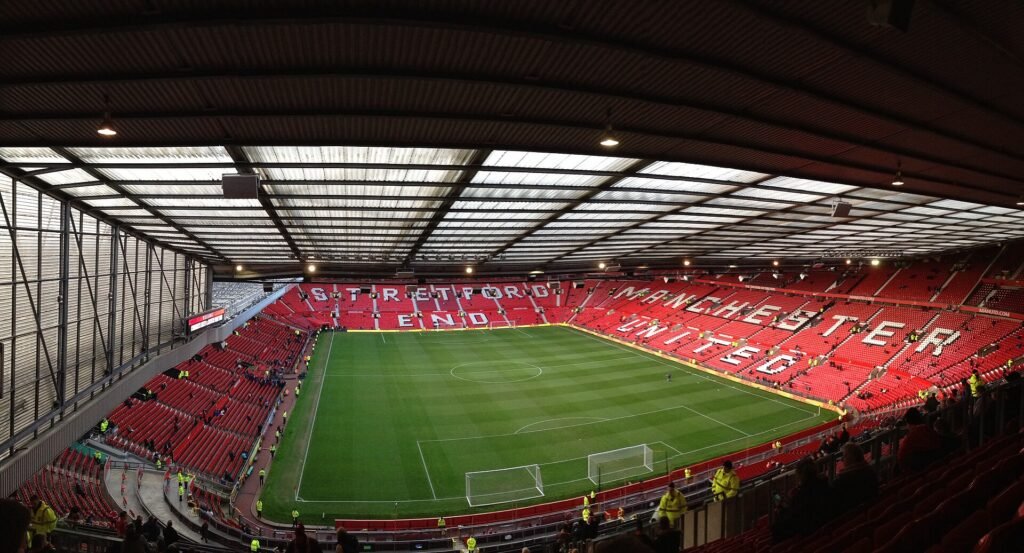
Water pouring through the roof onto supporters during a Premier League match is not the image Manchester United want attached to the Theatre of Dreams, yet footage of exactly that has circulated widely in recent seasons. It captures the central tension of a visit here. Old Trafford is the biggest club ground in England, holding 74,310 people, and one of the most storied stadiums anywhere, but it is also a building visibly straining to keep pace with the century it now finds itself in.
The club has responded by openly weighing whether to renovate the old ground or abandon it for a new 100,000-seat stadium next door. Anyone visiting today, in other words, may be seeing a version of Old Trafford that will not exist in a decade, and that alone is a reason to go before the decision is made.
What follows is a clear-eyed account of the ground as it stands: where the atmosphere soars and where it falls flat, which seats hide a steel pillar in your eyeline, how to escape the tram crush afterwards, and what it actually costs to get in. The history and the scale justify the trip. The facilities will test your patience. Knowing which is which before you arrive is the difference between a great day and a frustrating one.
Quick Facts: Old Trafford at a Glance
Before the detail, here is a summary of the essentials. These are the numbers and facts useful to know before you plan a visit.
| Feature | Details |
|---|---|
| Capacity | 74,310 (largest club ground in England) |
| Opened | 19 February 1910 |
| Home Team | Manchester United |
| Location | Sir Matt Busby Way, Trafford, Greater Manchester |
| Nearest Transport | Old Trafford and Wharfside tram stops (Metrolink) |
| Nickname | The Theatre of Dreams |
| Cheapest Adult Ticket | Around £30-40 for lower-category league games |
| Away Ticket Cap | £30 (Premier League agreement) |
| Tour Price | Around £28 adult, £19 child |
| Largest Stand | Sir Alex Ferguson Stand (three tiers) |
As the table shows, Old Trafford is the biggest club ground in the country and one of the more affordable of the traditional giants to visit, provided you avoid the highest-category fixtures. The tram makes it easy to reach, though as we will explain, leaving afterwards is the harder half of the journey.
History and Origins: From 1910 to the Theatre of Dreams
Old Trafford opened on 19 February 1910, designed by the renowned Scottish stadium architect Archibald Leitch, whose work shaped many of Britain’s early grounds. Manchester United moved from their previous home at Bank Street in Clayton, and the new stadium was considered one of the most advanced of its era, with a then-enormous planned capacity and generous facilities for the time.
For a ground with such a long history, remarkably little of the original structure survives, and the reason is a piece of history the club would rather forget. Understanding how the stadium was rebuilt explains a great deal about why the seating quality varies so sharply from one part of the ground to another today.
The Munich Connection and the Post-War Rebuild
Old Trafford was severely damaged by German bombing in March 1941, which destroyed much of the main stand and part of the terracing. Manchester United were forced to play their home games at Maine Road, Manchester City’s ground, for eight years while the stadium was rebuilt. United did not return to Old Trafford until 1949.
The post-war reconstruction was done quickly and economically, using the building methods of the period. Those methods relied on roof supports resting on pillars within the seating areas, and that single decision is the direct cause of the restricted-view seats that still exist in parts of the ground today. It is a real quirk of the stadium’s history that its most famous drawback traces back to a wartime bomb.
The 1958 Munich air disaster, in which eight Manchester United players died along with club staff and journalists, is woven into the fabric of the club and the ground. A memorial clock stopped at the time of the crash sits on the exterior of the South East corner, and the tunnel area carries tributes. It is a sombre and important part of any visit, and the museum handles the story with real care.
Why the Ground Stopped Growing
The most significant modern expansions came in the 1990s and 2000s. The North Stand, now the Sir Alex Ferguson Stand, was rebuilt as a three-tier structure in 1996, and the second tiers of the East and West Stands were added around 2000, pushing capacity to a peak of roughly 76,000 before safety adjustments brought it to the current 74,310.
The reason the ground has not grown further is simple and physical: a railway line runs directly behind the Sir Bobby Charlton Stand on the south side. That line makes it impossible to add a matching third tier to that stand, which is why Old Trafford looks noticeably lopsided from the outside, with one enormous side and one comparatively low one. This constraint is central to the debate about whether the club should redevelop the existing ground or build an entirely new stadium nearby, which we return to later in this review.
The Matchday Atmosphere: Big Nights Versus Quiet Afternoons
This is where expectations most need managing, because the atmosphere at Old Trafford varies more dramatically than at almost any comparable ground. It is capable of being one of the great experiences in English football, and it is equally capable of being surprisingly flat.
For a Champions League knockout night, a Manchester derby against City, or a visit from Liverpool, the ground is loud and the Stretford End drives it. Seventy-four thousand people generating noise inside a large enclosed bowl produces something worth travelling for, and the old songs still carry real weight on those occasions.
For a routine league fixture against smaller opposition, however, the ground can be quiet in a way that surprises first-time visitors. This is a long-standing criticism that United’s own supporters raise regularly. A ground this large spreads sound out, and when a meaningful share of the crowd on a given day is made up of tourists and occasional visitors rather than regulars, the singing simply does not carry the way it does at a smaller, tighter stadium.
The practical takeaway is that the fixture matters far more than the venue when it comes to atmosphere. If a real noise and a special occasion are what you are chasing, choose a big European night or a derby over a midweek cup tie against lower-division opposition. Do not judge the ground by its quietest afternoons, and equally do not expect its loudest nights every week.
Inside the Ground: Stands, Sightlines and the Pillar Problem
Old Trafford is a four-sided bowl, but an unusual one, because the four stands are so different in height and age. Knowing which is which before you book will make a real difference to your day, since the gap between the best and worst seats here is wider than at a modern stadium built in one go.
The Sir Alex Ferguson Stand runs along the north side and is the tallest section, a three-tier structure that dominates the skyline around the ground. The Sir Bobby Charlton Stand faces it on the south side and is much lower because of the railway line behind it. The Stretford End sits behind one goal to the west, and the East Stand behind the other holds the away supporters in one corner along with the museum and ticket office entrances.
The Stretford End and Where the Noise Comes From
The Stretford End is the traditional home of United’s most vocal support, and it is where the singing starts and is sustained. Historically a terrace, it is now all-seater, but supporters here stand for long stretches regardless, and the lower tier in particular is where the atmosphere is concentrated on the days it exists.
If atmosphere is your priority, this is the end to aim for, and specifically the lower tier. The trade-off is the viewing angle: from behind the goal you lose some sense of depth, and play at the far end of the pitch is harder to read than from a seat along the side. It is the classic exchange of a better view for a better feeling, and which matters more is a personal choice.
The corner where the Stretford End meets the Sir Alex Ferguson Stand is a reasonable compromise, offering a share of the noise with a more forgiving angle on the pitch. For a first visit where you want both the atmosphere and a decent view, that corner is worth considering.
Restricted View Seats You Should Avoid
This is the single most important practical warning in this review. Old Trafford has restricted-view seats caused by the roof-support pillars in the older parts of the ground, and their severity varies enormously.
The affected seats are concentrated in sections of the Sir Bobby Charlton Stand and parts of the East Stand, the areas that escaped the full 1990s redevelopment. The club is required to mark these seats as restricted view when it sells them, and they are priced lower to reflect the obstruction. That discount can be tempting, but it is not always worth taking.
The problem is that some restricted seats lose only a corner of the pitch, which barely affects the match, while others have a steel pillar directly in the line of play towards one goal, which means leaning around it for ninety minutes and missing moments of action. Always check the specific block and row before buying, and where possible look at a photograph taken from that seat, because the discount does not tell you which kind of obstruction you are getting.
The back rows of the Sir Alex Ferguson Stand upper tier are worth a separate mention. The view from up there is excellent and often the best value in the ground, but the height is considerable and the climb is long. If stairs are difficult for you, factor that in before booking the very top of the ground.
Facilities: Where Old Trafford Shows Its Age
This is the weakest part of the Old Trafford experience, and it is where the gap between the ground and the newest English stadiums is most obvious.. plainly not glossed over.
The concourses in the older stands are narrow, and at half time they become congested. Getting a drink and returning to your seat within the fifteen-minute break can be difficult, and the queues move slowly. The toilet facilities in these areas are dated and there are not enough of them for the crowd size. It is a common and entirely fair complaint.
The food offering is basic: pies, burgers and hot drinks at prices that feel high for what you receive. There is nothing here comparable to the food halls and microbrewery at Tottenham’s stadium, and if you are used to what the newer grounds provide, this will register as a clear step down.
The roof has also been a recurring and widely reported problem, with leaks during heavy rain affecting seats in several sections in recent seasons. Images of water pouring through the roof during matches have circulated widely, and the club has acknowledged the issue. It forms part of the broader argument that the ground needs either major investment or replacement, which we come to shortly.
None of this makes Old Trafford a bad day out, but it does mean arriving with the right expectations. Treat the dated facilities as part of the character of an old ground rather than a reason to stay away, and plan around them by eating before you arrive.
Getting There and Away
Reaching Old Trafford is straightforward; leaving it is the part that catches people out. The tram is the main option for most visitors, with the Old Trafford and Wharfside stops both serving the ground directly, and Exchange Quay a slightly longer walk that is usually less crowded.
There is also a railway station called Manchester United Football Ground, which operates only on matchdays with a limited service from Manchester Piccadilly and Oxford Road. It is convenient when it runs, but the service is sparse, so check times carefully instead of relying on it.
Walking from Manchester city centre takes around forty minutes along a straightforward route, and a large number of regular supporters do exactly this in at least one direction. It is often the most reliable option, particularly on the way back.
The departure is slow. After a full house the tram queues are long and the platforms fill quickly, and stewards manage the flow rather than letting everyone rush at once. Walking back towards the city centre is frequently faster than waiting, and if you have a train to catch from Piccadilly or Victoria you should allow well over an hour from the final whistle. Missing a booked connection because the tram queue took longer than expected is the most common way a good day here ends badly. Driving is not advisable, with limited and expensive parking, road closures on matchdays, and slow exits afterwards.
Ticket Prices and How to Actually Get In
Manchester United, like most Premier League clubs, price their matches in categories based on expected demand over charging the same for every fixture. Games against the biggest opponents and in European competition fall into the highest category, while fixtures against newly promoted sides and early cup rounds sit at the bottom.
This means the same seat can cost very different amounts depending on the opponent. Lower-category league tickets start at a more modest level, while high-category matches against the biggest clubs cost considerably more. If your goal is simply to see Old Trafford rather than a specific opponent, choosing a lower-category fixture is the single largest saving available, and the stadium experience is identical.
Availability is the bigger obstacle than price for most people. A large proportion of the 74,310 capacity goes to season ticket holders and official members, who get access to sale windows before the general public. What remains for general sale is limited, and for high-category fixtures it can be very limited indeed. Membership is the practical route in for anyone who wants to attend more than occasionally.
Two important points on getting a ticket safely. Away tickets are capped at £30 under a Premier League agreement, which makes the away section by far the cheapest way into the ground if you support the visiting team, though these are distributed by the away club to its own members. And be extremely careful with resale: the unauthorised resale of football tickets is a criminal offence in England, and the club cancels tickets it identifies as resold, so use only the official club ticket exchange.
The Museum and Stadium Tour
The Old Trafford museum is one of the best attached to any football ground, and it opened in 1986, making it one of the earliest club museums in the world. The collection is substantial, and for anyone unable to get a match ticket, the tour is arguably better value than a seat at a low-profile league game.
The historical coverage is the real strength. The Busby Babes, the Munich air disaster, the rebuilding of the team and the 1968 European Cup win are all covered properly rather than skimmed, and the treatment of the Munich story in particular is handled with genuine sensitivity. The trophy displays and the material on Sir Alex Ferguson’s long era are similarly thorough.
The tour itself includes the dressing rooms, the players’ tunnel, a seat in the dugout and pitchside access, and it runs on most non-matchdays. Standing at the edge of the pitch and looking up at the scale of the Sir Alex Ferguson Stand is the moment most visitors remember. Adult tickets are around £28 with child and family options available, and booking in advance is sensible, particularly in summer and school holidays.
The Redevelopment Question: Rebuild or Replace
No review of Old Trafford written now can ignore the biggest question hanging over the ground: whether it should be extensively renovated or replaced entirely by a new stadium built nearby.
The case for a new build rests on the constraints described earlier. The railway line behind the Sir Bobby Charlton Stand caps expansion on that side, the older stands carry restricted-view pillars, the concourses and facilities are dated, and the roof has leaked. Fixing all of that within the existing footprint is difficult and expensive, and it would require the club to play elsewhere for extended periods.
Following the arrival of Sir Jim Ratcliffe’s INEOS as a minority investor with responsibility for football operations, the club convened a task force and unveiled proposals for a new 100,000-capacity stadium on land adjacent to the current ground, with a striking design concept made public in 2024. Nothing has been finally confirmed, and the plans, the funding and the timeline all continue to develop, so any visitor should treat this as an evolving situation instead of a settled outcome.
For a supporter or a neutral planning a visit, the practical implication is simple: if seeing the historic Old Trafford matters to you, there is genuine value in doing it sooner rather than later, because the ground as it stands today may not be here indefinitely.
How Old Trafford Compares to Other English Grounds
Set against Tottenham Hotspur Stadium, which opened in 2019, the gap in facilities is stark. Tottenham offers wider concourses, faster service, far better food, cleaner facilities and no obstructed views. On every measurable comfort factor, the newer ground wins clearly, and it is the sharpest illustration of how far behind Old Trafford’s amenities have fallen.
Against Anfield, the comparison is closer and more interesting. Anfield is smaller but has a stronger and more consistent atmosphere for ordinary league games, driven by a more local crowd, while Old Trafford has the greater scale and, on its best nights, a comparable noise. Anfield’s recent expansions have also given it more modern sections than Old Trafford currently has.
Where Old Trafford still wins outright is size and history. No English club ground holds more people, and few carry the same weight of stories, from the Busby Babes to the treble-winning side of 1999. For scale and sense of occasion on the right night, it remains near the top of the English game, even as the building itself falls behind.
The Area Around the Ground
Old Trafford sits in Trafford, just outside Manchester city centre, in an area that is largely industrial and residential rather than a destination in its own right. The matchday atmosphere is concentrated along Sir Matt Busby Way, the main approach, which fills with food stalls, programme sellers and merchandise stands.
The statue of Sir Matt Busby outside the East Stand and the United Trinity statue of Best, Law and Charlton opposite are the traditional meeting and photograph points, and both get busy closer to kick-off, so allow time if you want a picture without a crowd. The pubs in the immediate area fill very early and many operate entry restrictions on matchdays, so most visitors drink in the city centre beforehand.
One point of real confusion for visitors is that Old Trafford Cricket Ground, a completely separate venue, sits a short distance away and shares a similar name. Make sure any taxi or map directions point to the football ground not the cricket ground, as mixing the two up is a surprisingly common mistake.
Tips for a First Visit
A few practical pointers will make a first visit to Old Trafford considerably smoother, drawn from the points above and worth pulling together in one place.
Choose your fixture for the experience you want. A big European night or a derby delivers the atmosphere the ground is famous for; a midweek game against lower-division opposition will not. Manage your expectations accordingly rather than judging the ground by the wrong match.
Check your seat before you buy. Avoid the restricted-view pillars in the older stands unless the discount is worth a compromised view, and look for a photograph from the specific block. Arrive early, ideally ninety minutes before kick-off, both to see the statues and museum exterior and to beat the slow turnstile queues and congested concourses.
Eat before you go in. The food inside is basic, expensive and slow to serve, so a meal beforehand saves both money and most of the half-time break. Bring warm layers, because you sit still for two hours and the upper tiers are exposed, and waterproofs in winter given the roof’s known issues. Finally, plan your journey home before you set off, and be prepared to walk back towards the city centre instead of queueing for a tram.
Overall Verdict
Old Trafford is worth visiting for the scale and the history, and both are real. Standing in a ground that holds 74,000 people, with the weight of everything attached to it, is an experience that newer and more comfortable stadiums simply cannot manufacture.
But it must be said clearly that the facilities have fallen behind. The concourses are cramped, the queues are slow, the food is poor and parts of the building are visibly tired. If you arrive expecting the comfort of a modern stadium, you will be disappointed, and the atmosphere on a quiet league afternoon will not match the reputation either.
Go for the right fixture, arrive early, use the tram or walk in, eat beforehand and treat the dated facilities as part of the character of an old ground. On that basis, Old Trafford remains one of the stadiums every football supporter should see at least once, and with a new ground now openly under discussion, there is a real argument for seeing the historic version while it still stands.
📚 From the Blog
Image credit: Stacey MacNaught / Wikimedia Commons (CC BY 2.0)