
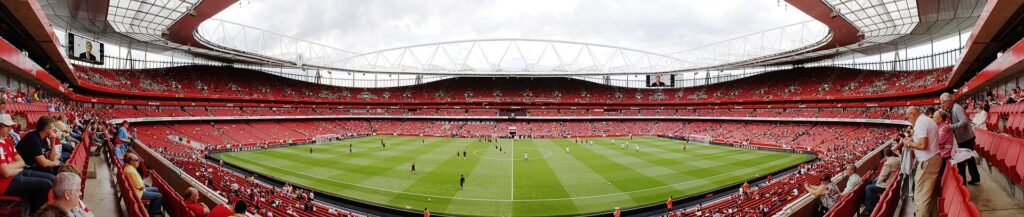
Opposing supporters call it the Library, and Arsenal’s own fans have never quite shaken the nickname off. It is unfair, and it is not entirely wrong, and holding those two things together is the only way to review the Emirates Stadium properly. This is one of the most comfortable and best-connected grounds in the country, and also the one whose atmosphere is questioned more than any other.
The reason traces back to a decision made in 2006, when Arsenal left Highbury, a tight, loud, listed old ground that could not be expanded, for a modern bowl holding twenty thousand more people. They gained the income to compete and the comfort of a new build. They gave up some of the intimacy that once made the old place roar, and they then spent more than a decade paying down the debt that made the move possible.
That trade still shapes a matchday in Islington today. On the pages below we set out why the atmosphere criticism persists and where it breaks down, which seats offer the best value and the most noise, why the transport beats every other major English ground, and how the ghost of Highbury lingers over the whole experience.
Quick Facts: Emirates Stadium at a Glance
Here are the essentials before the detail, covering the numbers and practical points useful to know before a visit.
| Feature | Details |
|---|---|
| Capacity | 60,704 (fourth largest club ground in England) |
| Opened | 2006 |
| Home Team | Arsenal |
| Previous Ground | Highbury (1913-2006, capacity around 38,000) |
| Design | Four-tier continuous bowl |
| Nearest Stations | Arsenal, Holloway Road, Finsbury Park |
| Quietest Section | Club Level (the middle tier) |
| Best Value Seats | Upper tier, especially the corners |
| Away Ticket Cap | £30 (Premier League agreement) |
As the table indicates, the Emirates is at its strongest on transport and comfort and at its weakest on atmosphere, with the middle Club Level tier being the quietest part of the ground. Knowing where the noise is, and is not, is the single most useful thing for a first-time visitor to understand.
Why Arsenal Left Highbury
The context matters here more than at most grounds, because it explains both the stadium’s strengths and its weaknesses. Highbury held around 38,000 and had a reputation as one of the better atmospheres in London, helped by being small, tight and enclosed with stands close to the pitch and a roof that trapped sound.
The problem was that Highbury could not be expanded. It was surrounded by residential streets, and two of its stands, the art deco East and West Stands, were listed buildings that could not legally be altered. Arsenal were generating far less matchday income than rivals in larger grounds, and the gap was widening every season, threatening the club’s ability to compete.
How the Move Was Financed
The new stadium cost around £390 million to build, and the total cost including land and associated works was considerably higher. The debt taken on to finance it shaped the club’s transfer budget and wage structure for well over a decade, a period during which Arsenal were often criticised for failing to compete for the biggest signings.
Part of the financing came from an unusual source: the old Highbury ground was redeveloped into flats, marketed as Highbury Square, with the art deco facades preserved and the former pitch turned into a communal garden. For a first-time visitor, the old site is worth the short detour on the way in, both for the preserved architecture and for the sense of what was traded for the move.
Capacity rose by more than twenty thousand seats, which should in theory have eased the scarcity that drives high prices, but demand rose to meet it and Arsenal moved into the upper tier of Premier League pricing rather than the middle. More seats, as at other clubs that have moved to larger grounds, did not translate into cheaper seats.
The Approach and the Setting
The walk to the ground from Drayton Park or Holloway Road passes a series of murals showing former players, added deliberately to give the newer stadium a visible connection to the club’s history. The Ken Friar Bridge and the cannon sculptures are the usual meeting points, and statues of Thierry Henry, Tony Adams and Herbert Chapman stand outside the ground.
The Emirates sits in Holloway in the London borough of Islington, in an area that is part of the city over an out-of-town site surrounded by car parks. That location means there are real pubs, cafes and restaurants within walking distance along Holloway Road and Blackstock Road, which fill up on matchdays but offer more options than grounds tucked into purely residential districts.
The detour past the old Highbury site is worth building into a first visit. The preserved facades are visible from the street, and the former pitch is now a private communal garden, which gives the day some genuine historical context that the modern stadium alone cannot provide.
The Wenger Era and the Self-Sustaining Model
The Emirates cannot be understood separately from Arsène Wenger, the manager who ran Arsenal from 1996 to 2018 and who oversaw both the move and the long financial squeeze that followed it. Wenger was central to the case for the stadium, having transformed Arsenal into a side that could fill a much larger ground, and he then spent years managing the consequences of the debt taken on to build it.
The period is often described as the self-sustaining model. While rivals spent heavily, Arsenal operated within tight constraints because so much of the club’s income was committed to servicing the stadium debt. Wenger was frequently criticised for failing to sign the biggest players, and while the club remained competitive and qualified for the Champions League every season for a remarkable run, it did not win the league during that time.
Understanding this history changes how you see the ground. The Emirates was not simply a comfort upgrade; it was a long-term financial gamble that shaped the club’s fortunes for more than a decade, and the murals and statues around the ground celebrate a golden era, the Invincibles among them, that largely predated the move. The stadium is the monument to a bet on the future that took years to pay off.
Inside the Ground: A Bowl With No Bad Views
The Emirates is a four-tier continuous bowl with clean sightlines from essentially every seat. There are no supporting pillars and no obstructed views anywhere, which is the standard benefit of building from scratch and a real improvement on the older grounds where restricted-view seats are a real hazard.
The lower tier is closest to the pitch and the most expensive. Above it sits Club Level, a full tier of premium seating with padded seats and access to indoor bars and restaurants, sold on a membership basis not through general ticket sales. Above that is a narrow tier of executive boxes, and then the upper tier, the largest section by capacity and the cheapest.
The upper tier deserves particular mention as the best value in the ground. The rake is steep enough that you look down on the pitch and can read the shape of the game clearly, which is often a better way to watch football than sitting at pitch level, and the corner seats up there are the cheapest tickets available. Seats throughout are wider with more legroom than at older London grounds, and the concourses are broad and do not become impassable at half time.
The Atmosphere Problem, Explained Fairly
This is the criticism that follows the ground everywhere, and it deserves a proper explanation rather than simple repetition or dismissal. The nickname the Library is unkind but not entirely unearned, and the reasons for it are structural as much as anything.
Highbury was small, tight and enclosed, with stands close to the pitch and a roof that trapped sound. The Emirates is a large open bowl, and bowls spread sound outwards and upwards instead of reflecting it back down onto the pitch. Noise dissipates instead of building, which is a real acoustic disadvantage that no amount of encouragement fully overcomes.
There is also the composition of the crowd and the layout. Club Level occupies a full tier around the middle of the ground and is the quietest part of any stadium, because those seats attract a different kind of attendance. Placing that tier between the lower and upper sections effectively divides the noisier supporters into two separated groups, which weakens the collective effect considerably.
The club has worked to address it, moving the more vocal supporters into a designated area behind one goal and introducing safe standing in 2022. Those measures have helped, and the lower corners of the North Bank are now the liveliest part of the ground. The honest position is that the Emirates is quieter than Anfield, Celtic Park or Dortmund, and quieter than Highbury was, but it is not silent, and on a European night against strong opposition it is loud. The gap between reputation and reality is smaller than the jokes suggest.
Safe Standing and the Fight for Atmosphere
Arsenal were among the first Premier League clubs to introduce licensed safe standing when the rules changed in 2022, installing rail seating that gives each supporter a barrier and a numbered space while allowing them to stand for the full match legally. The safe-standing areas are concentrated in the lower tier behind the goal, in and around the North Bank.
The effect has been genuine if modest. A section where supporters stand together and behave as one group generates more noise than the same number seated and separated, and the lower North Bank corners are now clearly the liveliest part of the ground. It does not transform the whole bowl, because the acoustic problem of a large open stadium remains, but it concentrates the atmosphere where a first-time visitor chasing noise should aim to sit.
Food, Drink and Facilities
Facilities are good without being exceptional. The concourses are wide, the toilets are adequate in number, and service is reasonably quick, all of which are real advantages over the older London grounds where half time can disappear entirely into a queue.
The food range is better than at older grounds but behind Tottenham, with standard stadium options supplemented by a few better choices, and the club has expanded the range in recent years. Prices are high, which is normal for London, so eating before you arrive remains the sensible approach unless you specifically want the experience.
The overall impression inside is of a stadium that is comfortable and easy to move around, which sounds unremarkable until you compare it with the cramped concourses and slow queues of a ground built decades earlier. Comfort is the Emirates’ quiet strength.
Getting There and Away
This is the Emirates at its strongest, and it deserves emphasis because it is rarely mentioned. Arsenal station on the Piccadilly line sits a few minutes’ walk from the ground, with Holloway Road slightly further and Finsbury Park around ten minutes away, connecting to the Victoria line and to National Rail.
Having three stations within walking distance means the crowd spreads across them rather than funnelling into one, which is why leaving the Emirates is easier than leaving most large grounds. Arsenal station operates as exit-only after matches to manage the flow, which sounds inconvenient but works well in practice.
Walking to Finsbury Park afterwards is the standard advice and it is good advice: you avoid the worst congestion and have more onward options when you arrive. Compared with Anfield, where there is no nearby station at all, or Old Trafford, where the tram queues are long, the Emirates is convenient, and you can expect to be on a train within about thirty minutes over the hour or more needed elsewhere. Driving is not advisable, with matchday parking restrictions covering a wide area of Islington.
Ticket Prices and Availability
Arsenal use a category system, with prices varying by opponent and competition. Lower-category league games are considerably cheaper than matches against the biggest clubs, and cup competitions are frequently the cheapest fixtures of all with much better availability. If you simply want to visit the ground, a low-category fixture is the largest saving available.
The upper tier is the best value, and the difference between an upper-tier seat and a lower-tier seat is substantial for a view that many consider better. Availability is the harder problem: season ticket holders and members take most tickets, and general-sale availability for major fixtures is limited, so membership improves your access and is worth considering for more than one visit.
Away tickets are capped at £30 by Premier League agreement, making the away section the cheapest route in for visiting supporters. As everywhere, unauthorised resale is a criminal offence and the club cancels tickets it identifies as resold, so use only the official club ticket exchange.
The Stadium Tour and Museum
For anyone unable to get a match ticket, the tour is a reasonable alternative and runs on most non-matchdays. It covers the dressing rooms, the tunnel, the directors’ box and pitchside, and the museum holds a strong collection covering the Herbert Chapman era of the 1930s, the Invincibles season of 2003-04 when Arsenal went unbeaten in the league, and the move from Highbury.
It is well priced compared with a matchday ticket, and for visitors to London who cannot get a ticket, it is a sensible way to see the ground and understand the club’s history. The Invincibles material in particular is worth the visit for anyone who remembers that side.
How the Emirates Compares to Other Grounds
Against Old Trafford and Anfield, the Emirates is more comfortable, easier to reach and has better sightlines, but it has less atmosphere and less accumulated history. It is the trade-off between a modern bowl and an old ground in its clearest form.
Against Tottenham Hotspur Stadium, which is also modern, the Emirates loses on food, drink and the quality of the home end, but has better transport connections. The two are the closest comparison in London, and most neutrals would give Tottenham the edge on the building while acknowledging the Emirates is the easier ground to get to and from.
Against European grounds such as the Allianz Arena, the Emirates is far more expensive for a comparable standard of facilities. Its real strength is that nothing about visiting is difficult, and for a first football match, or for anyone bringing children, that counts for a great deal more than the atmosphere criticism suggests.
The Area Around the Ground
The Emirates sits in Holloway in the London borough of Islington, an area that is part of the city rather than an out-of-town site surrounded by car parks. That location means real pubs, cafes and restaurants along Holloway Road, Blackstock Road and around Highbury Corner, which fill on matchdays but offer far more options than grounds tucked into purely residential districts.
The Armoury, the main club shop, is on site next to the ground and is busy before and after matches, with prices identical on quieter non-matchdays. The King’s Road area and Islington more widely are well supplied with places to eat, so a matchday can easily be built around a meal before or after without needing to travel into central London.
The walk between the ground and Finsbury Park passes through residential streets and part of the park itself, which makes it a more pleasant departure than the walk away from most stadiums, and it is the route we would recommend for anyone heading onward by rail.
Tips for a First Visit
A few practical pointers, drawn together, will help you get the most from a visit to the Emirates and avoid the mistakes that lead to the atmosphere disappointment.
Book the upper tier if you want value, because the view is excellent and the saving over the lower tier is significant. Book the lower sections behind the goals, particularly the North Bank corners, if you want noise, and avoid Club Level if atmosphere matters to you, because it is comfortable but the quietest part of the ground.
Arrive early enough to see the old Highbury site if it is your first visit, a ten-minute detour that gives the day real context. Walk to Finsbury Park afterwards rather than queueing at Arsenal station. Bring layers for evening games, because the bowl allows wind to circulate and the upper tier is exposed. And choose a European night or a London derby over a midweek league game if the atmosphere is what you are chasing, because the difference is real.
Overall Verdict
The Emirates is an easy, comfortable stadium with excellent sightlines and the best transport links of any major English ground. Nothing about visiting is stressful, which matters more than people admit, and for a first match or a family day out it is one of the better choices in the country.
The atmosphere criticism is fair but overstated. Choose a European night or a London derby instead of a midweek game against weak opposition, sit in the lower tier behind a goal if noise matters to you, and the ground delivers far more than its Library nickname suggests.
Go in understanding what the move from Highbury traded away, and what it gained, and the Emirates makes complete sense: a comfortable, convenient, modern stadium that gave up some of its predecessor’s intimacy for the scale a top club needs. On its own terms, it succeeds, and the atmosphere is a smaller problem in person than its reputation implies.
📚 From the Blog

Image credit: Ed g2s / Wikimedia Commons (CC BY-SA 3.0)