
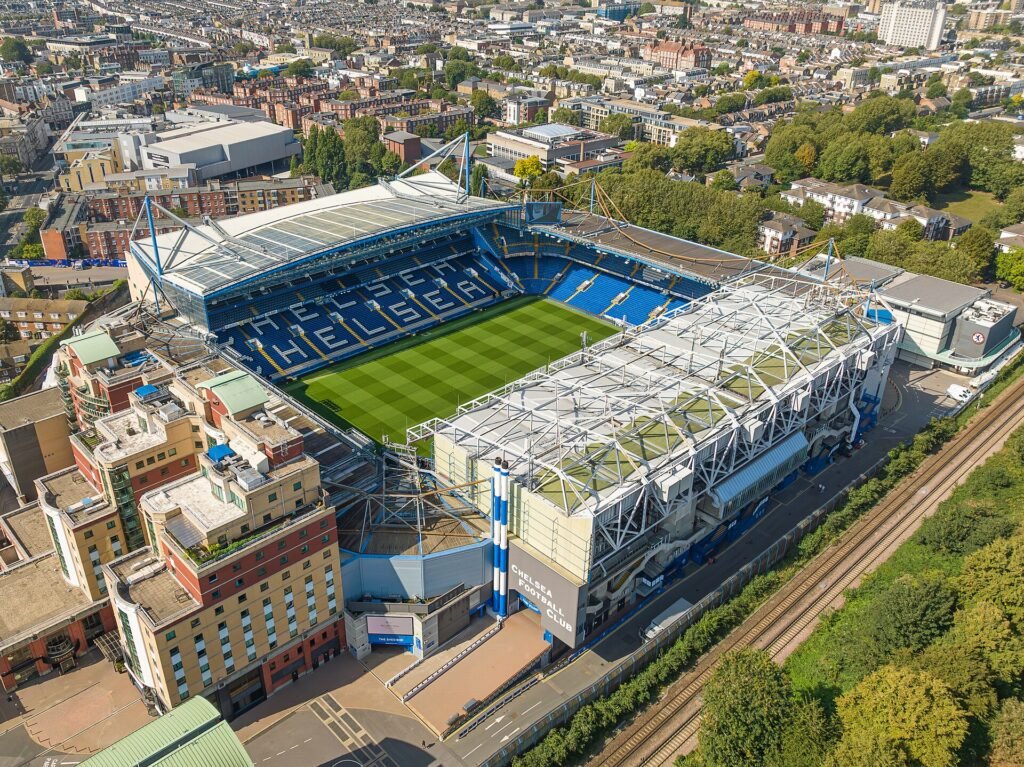
Stamford Bridge is one of the older Premier League grounds and it sits in a tight residential part of west London, hemmed in by railway lines, housing and a main road. That constrained site shapes almost everything about visiting, from the capacity to the concourses to how long it takes to get away afterwards. It is a ground that rewards those who understand its quirks and punishes those who do not plan ahead.
It holds around 40,000 people, which is small for a club that has competed at the top of European football for two decades. Chelsea have wanted to expand or rebuild for years and have repeatedly run into the physical limits of the location. The result is a stadium that feels intimate and atmospheric but also cramped and dated in places. This review covers the history that produced such an unusual ground, what it is genuinely good at, where it falls short, and the practical details worth knowing before a first visit.
Whether you are a Chelsea supporter planning your first match at Stamford Bridge or a visiting fan looking for an authentic London football experience, this guide gives you everything you need to know. We cover not just the history and atmosphere but the practical reality of visiting: where to sit, how to get there, what to expect from the facilities, and how to avoid the common pitfalls that catch first-time visitors.
One important note: Stamford Bridge is not a comfortable stadium by modern standards. The concourses are narrow, some seats have restricted views, and the facilities are dated. But it has character and atmosphere that many newer stadiums lack, and for many visitors that trade-off is worth it. The key is knowing what you are getting into and planning accordingly.
History and Origins: The Ground That Created the Club
Stamford Bridge has a founding story that reverses the usual order, and it explains a lot about the shape of the place. The ground opened in 1877 as an athletics venue and was used for that purpose for nearly thirty years. In 1904 it was bought by businessmen who intended to stage football there, and they offered it to Fulham, who turned it down. Rather than abandon the plan, the owners formed an entirely new club to play at the ground. That club, founded in 1905, was Chelsea. So the stadium is nearly thirty years older than the team that plays in it.
In its early form it was enormous, designed to hold over 80,000 people, and it hosted three FA Cup finals between 1920 and 1922 before Wembley opened. The oval shape of the original athletics track meant the stands were a long way from the pitch, which was a serious drawback for football and was only fully resolved by later rebuilding. The ground was progressively rebuilt over the decades, with the East Stand completed in 1930, the West Stand in 1939, and the Shed End in 1965. The Matthew Harding Stand, the newest part of the ground, was completed in 1997.
The stadium has hosted some of the most significant matches in English football history, including the 1965 League Cup final, the 1970 FA Cup final replay, and the 1998 UEFA Cup Winners’ Cup final. It was also one of the venues for the 1966 World Cup, hosting three matches during the tournament. The ground has been home to Chelsea throughout their history, from their founding in 1905 to their Champions League triumphs in 2012 and 2021. The stadium’s museum covers the club’s history from its founding to the present day, and it is one of the most comprehensive club museums in England.
The Redevelopment Debate
The reason Stamford Bridge is small is straightforward and it has no easy solution. A railway line runs along one side of the ground. Residential streets press against the others. The Fulham Road runs across the front. There is simply no space to extend outwards, and building upwards has its own limits because of the impact on surrounding housing and the need for planning consent from neighbours. Chelsea have produced several redevelopment proposals over the years, including a full rebuild on the same site that would have required the club to play elsewhere for an extended period. These have been shelved and revived more than once.
The alternative, moving to a new site, has been discussed but is unpopular with supporters and difficult to achieve in that part of London. The practical result is that Chelsea generate significantly less matchday income than clubs with 60,000 or 70,000 seat grounds, and ticket demand consistently exceeds supply. The club has explored options including a move to Battersea Power Station and a redevelopment of the existing site, but both have faced significant obstacles. The redevelopment debate is likely to continue for years, and the future of Stamford Bridge remains uncertain.
What It’s Like Inside: Atmosphere and Sightlines
The compact site produces the ground’s main advantage, and it is a real one. The stands sit close to the touchlines with very little run off space. You are near the play in a way you are not in a large modern bowl, and that proximity affects both how well you see the game and how involved the crowd feels. The Shed End behind one goal holds the most vocal home supporters and is the source of most of the noise. The Matthew Harding Stand along one side is also lively. Atmosphere at Stamford Bridge is generally rated better than at the Emirates, and the tightness of the ground is the main reason. Sound has less space to escape into.
The sightlines are generally good throughout the stadium, though some seats in the older stands have restricted views due to supporting pillars. The East Stand and West Stand are the oldest parts of the ground, and they have the most issues with restricted views. The Matthew Harding Stand and the Shed End are more modern, and they have better sightlines. The pitch is in excellent condition, with a hybrid grass system that combines natural turf with synthetic fibres for durability. The drainage system is among the best in England, meaning matches rarely suffer from waterlogging even in heavy rain.
The atmosphere at Stamford Bridge varies depending on the occasion. For routine league matches, the crowd can be surprisingly quiet for a stadium of this size. But on big occasions, such as Champions League nights or derby matches against Arsenal or Tottenham, the atmosphere can be electric. The Shed End is the most vocal section, and it produces an intense atmosphere during high-stakes matches. The club has invested in improving the atmosphere in recent years, with initiatives including the appointment of a head of fan engagement and the introduction of a new pre-match playlist.
Restricted View Seats: What to Know
This is where the age of parts of the ground causes genuine problems, and it needs to be flagged clearly. Some sections have supporting pillars that obstruct the view. These seats are marked as restricted view when sold and are priced lower, but the extent of the obstruction varies considerably. A pillar directly in your line of sight to one goal is a real problem across ninety minutes. Always check the specific block and row before buying rather than assuming a restricted view marking means a minor inconvenience. Where possible, look for a photograph taken from that seat.
The worst affected sections are in the East Stand and the lower tier of the West Stand. The Matthew Harding Stand and the Shed End have fewer restricted view seats, but they still exist. The club has been working to reduce the number of restricted view seats through redevelopment, but the physical constraints of the site mean that some will always remain. If you are planning a visit, book a seat in the Matthew Harding Stand or the upper tier of the West Stand for the best views. Avoid the lower rows of the East Stand, which have the most restricted views.
Facilities and Amenities
Facilities are dated and the concourses are the weakest part of the ground. They are narrow, and at half time they become genuinely congested. Getting a drink and returning to your seat within the fifteen minute break is difficult in some stands. Toilet provision is tight for the crowd size and the food offering is basic and expensive, as it is at most London grounds. The one unusual advantage is that the site includes a hotel, several restaurants, a health club and a museum, all within the stadium complex. That is rare for an inner city ground and it means there is somewhere to go if you arrive early or want to wait for the crowds to clear afterwards.
The Chelsea Megastore is located at the end of the Fulham Road stand, and it is one of the largest club shops in England. The shop sells a wide range of Chelsea merchandise, including shirts, scarves, hats and other accessories. The museum is located within the stadium complex, and it covers the club’s history from its founding in 1905 to the present day. The museum includes original match-worn shirts, trophies, photographs and video footage from the club’s most famous matches. The stadium tour is available on non-matchdays and includes access to the dressing rooms, tunnel, pitchside and museum.
The stadium has two hotels within the complex: the Chelsea Village Hotel and the Millennium Hotel. Both hotels offer matchday packages that include tickets and accommodation, which is a convenient option for visiting supporters. The stadium also has several restaurants and bars, including the Blue Lion pub, which is popular with fans before and after matches. The area around the stadium has several other pubs and restaurants that are popular with fans, particularly along the Fulham Road.
Getting There and Away: Transport and Access
Fulham Broadway station on the District line is a few minutes walk from the ground, which sounds convenient and is on the way in. On the way out it is the main problem with visiting Stamford Bridge. The station is small relative to the crowd, and it becomes severely congested after the final whistle. Queues form on the street and it can take a long time to get onto a train. The practical alternatives are walking to West Brompton, Parsons Green or Earl’s Court, all of which take fifteen to twenty five minutes and are usually faster than waiting at Fulham Broadway.
Driving is not sensible. The area operates residential parking restrictions, spaces are minimal and the surrounding roads are heavily congested on matchdays. If you must drive, there is limited parking available at the stadium, but it fills up quickly and is expensive. The best option is to use public transport, and the District line is the most convenient. The stadium is also accessible by bus, with several routes stopping nearby. The number 14, 211 and 414 buses all stop near the stadium.
For visitors arriving from outside London, the easiest option is to take the train to Victoria or Paddington station and then transfer to the District line. The journey from Victoria takes approximately fifteen minutes, and the journey from Paddington takes approximately twenty minutes. The stadium is located in the Fulham district of west London, and the surrounding area is one of the most affluent parts of the city. The area is relatively quiet on non-matchdays, but it comes alive on matchdays with Chelsea supporters.
Ticket Pricing and Booking
Chelsea operate a category system with prices varying by opponent. Prices are high, as they are across London, and the limited capacity keeps demand well above supply. Adult tickets for category A matches (against top-six opponents) typically cost between £50 and £70, while category B matches cost between £40 and £55 and category C matches cost between £30 and £45. Children under 16 can purchase tickets at a discounted rate, and seniors over 65 also receive a discount. A family of four can expect to pay between £120 and £200 for tickets, depending on the category of the match.
Membership improves access to general sale and is worth considering if you plan more than one visit, since season ticket holders take a large share of the allocation. The club offers a Chelsea Membership scheme that provides priority access to tickets before they go on sale to the general public. The membership costs £35 per year and is worth it if you plan to attend more than two matches per season. The club also offers a “Chelsea Ticket” scheme for away supporters, which provides discounted tickets for visitors from other clubs.
Away tickets are capped at thirty pounds by Premier League agreement, which makes the away section the cheapest way in for visiting supporters. Reselling football tickets without authorisation is a criminal offence in England, and clubs cancel any identified as resold. Buy through official channels only. The club also offers a hospitality package that includes tickets, food and drink, and access to a private lounge. The hospitality package costs between £150 and £300 per person, depending on the category of the match.
How Stamford Bridge Compares to Other London Grounds
Against the Emirates, Stamford Bridge is smaller and less comfortable but has a better atmosphere and puts you closer to the pitch. The Emirates has far better transport, with the Arsenal station directly outside the stadium. The Emirates also has better facilities, with wider concourses and more food and drink options. But the atmosphere at the Emirates is generally quieter, particularly during routine league matches. If atmosphere is your priority, Stamford Bridge is the better choice. If comfort and convenience are your priority, the Emirates is the better choice.
Against Tottenham Hotspur Stadium, the gap in facilities is large and entirely in Tottenham’s favour. The Tottenham Hotspur Stadium is one of the most modern stadiums in England, with wide concourses, excellent sightlines, and a range of food and drink options. The atmosphere at Tottenham is also generally better, particularly during high-stakes matches. But Stamford Bridge has more character and history, and it is located in a more central part of London. If you want a modern stadium experience, Tottenham is the better choice. If you want a traditional London football experience, Stamford Bridge is the better choice.
Against older grounds elsewhere in England, Stamford Bridge is comparable in character but more expensive, reflecting its London location. Grounds like Anfield, Old Trafford and Goodison Park offer a similar mix of history, atmosphere and character, but they are generally cheaper to visit. The cost of visiting Stamford Bridge is one of the highest in English football, and it is a factor to consider when planning a visit. But the quality of the football on offer and the atmosphere on big occasions make it a worthwhile experience for many visitors.
Tips for a First Visit
Check your block carefully for restricted view markings, and look for a photograph from the seat if one is available. The worst affected sections are in the East Stand and the lower tier of the West Stand. The Matthew Harding Stand and the Shed End have fewer restricted view seats, and they are the best options for first-time visitors. Walk to West Brompton or Parsons Green afterwards rather than queueing at Fulham Broadway. The journey takes fifteen to twenty five minutes, and it is usually faster than waiting at Fulham Broadway.
Eat before you arrive, since the concourses are cramped and the queues are slow. The area around the stadium has several pubs and restaurants that are popular with fans before and after matches. The Blue Lion pub is particularly popular, and it is located within the stadium complex. Sit in or near the Shed End if atmosphere is your priority. The Shed End is the most vocal section, and it produces an intense atmosphere during high-stakes matches. Arrive early and use the on site facilities, which are better than at most grounds of this age. The museum and megastore are both worth visiting before the match.
Allow more time than you expect for the journey home. The station congestion after the match is significant, and it can take a long time to get onto a train. If you are travelling with children or elderly supporters, consider booking a seat in the Matthew Harding Stand, which has better facilities and easier access. The club also offers a “Sensory Friendly” matchday experience for supporters with autism, which includes reduced noise levels and a quiet space. The experience is available for selected matches, and it must be booked in advance.
The Area Around the Ground
Stamford Bridge sits in Fulham, one of the more affluent parts of west London, and the surroundings are noticeably different from the residential terraces around Anfield or the industrial setting of the Etihad. The Fulham Road running past the front of the ground has a long row of pubs, cafes and restaurants, and they fill early on matchdays. Because the area is busy independently of the football, there are more options than at grounds tucked into purely residential districts. The area is also well served by public transport, with several bus routes and the District line nearby.
The stadium complex itself contains two hotels, several restaurants, a museum and the club megastore, all built into the site over the years as the club tried to make commercial use of land it could not use for seating. That is a direct consequence of the expansion problem, and it means there is genuinely somewhere to sit before and after a match. The Blue Lion pub is particularly popular with fans, and it is located within the stadium complex. The pub offers a range of food and drink options, and it is a good place to meet other supporters before the match.
Brompton Cemetery sits immediately alongside the ground and the walk through it towards West Brompton station is a quiet and quick route away from the crowds after a match. Most visitors do not know it is there, which is precisely why it works. The cemetery is one of the “Magnificent Seven” cemeteries of London, and it is a beautiful and peaceful place to walk. The walk through the cemetery takes approximately ten minutes, and it is a great way to avoid the station congestion after the match.
Overall Verdict
Stamford Bridge is an older ground with genuine character, a good atmosphere and a view of the pitch that newer bowls cannot match. Being close to the play matters, and the tight site delivers that. The history of the ground is also significant, and it is one of the most iconic stadiums in English football. The club’s success in recent years has added to the ground’s reputation, and it is now one of the most sought-after tickets in English football.
The trade offs are real. Concourses are cramped, some seats have pillars in the way, facilities are dated and leaving through Fulham Broadway is the least pleasant departure of any London ground. But for many visitors, the atmosphere and character of the ground more than make up for these shortcomings. The key is knowing what you are getting into and planning accordingly. Check your seat before booking, plan to walk to a different station afterwards, and eat beforehand. Handle those three things and it is one of the more enjoyable London grounds to visit.
If you are a Chelsea supporter, Stamford Bridge is home, and it is a special place. If you are a visiting supporter, it is a ground that offers a genuine London football experience, with all the character and atmosphere that comes with it. The cost of visiting is high, but the quality of the football on offer and the atmosphere on big occasions make it a worthwhile experience for many visitors. Whether you are planning your first visit or your fiftieth, Stamford Bridge is a ground that rewards those who understand its quirks and plan accordingly.
📚 From the Blog


Image credit: Arne Müseler / Wikimedia Commons (CC BY-SA 3.0 de)