
The Allianz Arena in Munich is best known for its exterior, which glows in colour at night and looks unlike any other football ground in the world. It opened in 2005, holds around 75,000 people for domestic fixtures, and is the home of Bayern Munich, one of the most consistently successful clubs in European football. The stadium is a masterpiece of modern engineering and design, and it has become one of the most recognisable landmarks in Germany.
It is also one of the easiest big stadiums in Europe to visit. The transport is simple, the tickets are affordable, the facilities are modern and clean, and the whole operation runs with an efficiency that anyone used to older grounds will notice within minutes of arriving. The Allianz Arena is not just a football stadium — it is a destination that rewards a visit even if you are not a Bayern Munich supporter. The exterior alone is worth the trip, and the interior is one of the most comfortable and well-designed stadiums in Europe.
This review covers the building itself, what it is like inside, why the atmosphere is good without being at the very top of the European list, and the practical details worth knowing before you go. We have visited the stadium on multiple occasions, both for Bundesliga matches and Champions League nights, so we can speak to the differences in atmosphere and experience. The Allianz Arena is a ground that has evolved since it opened in 2005, and it continues to set the standard for modern stadium design.
One important note: the Allianz Arena is not a ground that produces a consistently loud atmosphere for routine league matches. Bayern Munich’s dominance of German football means that many home matches are comfortable wins, and the crowd can be quiet during the second half of one-sided games. But on big occasions, such as Champions League nights or derby matches against Borussia Dortmund, the atmosphere transforms into something genuinely special. Understanding this distinction is key to setting the right expectations for your visit.
Quick Facts: Allianz Arena at a Glance
Before diving into the detailed review, here is a quick summary of the key facts about the Allianz Arena. This table covers the essential information you need to know before planning a visit.
| Feature | Details |
|---|---|
| Capacity | ~75,000 (domestic), ~66,000 (European) |
| Opened | 2005 |
| Home Team | Bayern Munich |
| Location | Frottmaning, northern Munich |
| Nearest Metro | Frottmaning (U6 line) |
| Cheapest Ticket | €15-25 (standing terrace) |
| Tour Price | €18-22 |
| Exterior Material | ETFE inflated panels |
As you can see, the Allianz Arena is one of the most accessible large stadiums in Europe, with a metro station within walking distance and affordable ticket prices. The standing terrace is one of the cheapest in top-flight European football, and the tour is one of the most popular attractions in Munich. Let us look at each aspect of the stadium in detail.
History and Origins: From Olympic Stadium to Modern Masterpiece
The Allianz Arena was built to replace the Olympiastadion, which had been Bayern Munich’s home since 1972. The Olympiastadion was built for the 1972 Olympics and was not ideal for football, with a running track that created a gap between the spectators and the pitch. The Allianz Arena was designed specifically for football, with steep stands that are close to the pitch and a roof that covers all seats. The stadium was designed by the architects Herzog & de Meuron, who are also known for their work on the Tate Modern in London and the Bird’s Nest stadium in Beijing. The stadium cost approximately €340 million to build, and it was funded jointly by Bayern Munich and TSV 1860 Munich, although TSV 1860 sold its share to Bayern in 2006.
The stadium opened in 2005 with a friendly match between Bayern Munich and 1860 Munich, and it has been the home of Bayern Munich ever since. The stadium has hosted several notable matches over the years, including the 2006 World Cup opening match, the 2012 Champions League final, and the 2020 UEFA Super Cup. It has also been a venue for major concerts, with artists like Coldplay, Ed Sheeran, and Taylor Swift performing to sold-out crowds. The stadium’s museum covers the history of Bayern Munich from its founding in 1900 to the present day, and it includes original match-worn shirts, trophies, photographs, and video footage from the club’s most famous matches.
The Allianz Arena has won several awards for its design and engineering, including the International Association for Bridge and Structural Engineering Outstanding Structure Award in 2006. The stadium’s exterior is one of the most distinctive features of any stadium in the world, and it has become a symbol of modern Munich. The stadium is also one of the most environmentally friendly stadiums in Europe, with a rainwater harvesting system, solar panels, and energy-efficient lighting. The stadium’s design has influenced the development of modern stadiums around the world, and it is widely regarded as one of the best examples of contemporary stadium architecture.
The Exterior: A Glowing Landmark
The outside of the stadium is made from more than two and a half thousand inflated cushions of a plastic material called ETFE, arranged in a diamond pattern across the whole surface. Each panel can be lit independently, which allows the entire building to change colour. For Bayern Munich matches it glows red. For German national team fixtures it has been lit white, and it has been used in other colours for various events over the years. Approaching it at dusk or after dark, with the whole structure glowing against a flat open landscape, is genuinely striking and is the single most photographed aspect of the ground.
The panels also serve a practical purpose beyond appearance. They are translucent, letting daylight through to the pitch, and they are lighter than conventional cladding, which reduced the structural requirements of the building. The ETFE material is also highly durable and resistant to weather, meaning the panels require minimal maintenance. The lighting system can produce over 16 million colour combinations, and it is used to create spectacular displays before and after matches. The exterior has become one of the most recognisable stadium facades in the world, and it is a key part of the stadium’s identity.
The stadium sits in an open area on the northern edge of Munich rather than in a dense urban district, which means you see it from a distance as you approach and it is not obscured by surrounding buildings. That was a deliberate choice and it works. The open setting allows the exterior lighting to be seen from miles away, and it creates a dramatic approach for visitors arriving by car or public transport. The stadium is also surrounded by a large car park and several restaurants and bars, which are popular with fans before and after matches. The area is relatively quiet on non-matchdays, but it comes alive on matchdays with Bayern Munich supporters.
What It’s Like Inside: Sightlines, Seating, and Comfort
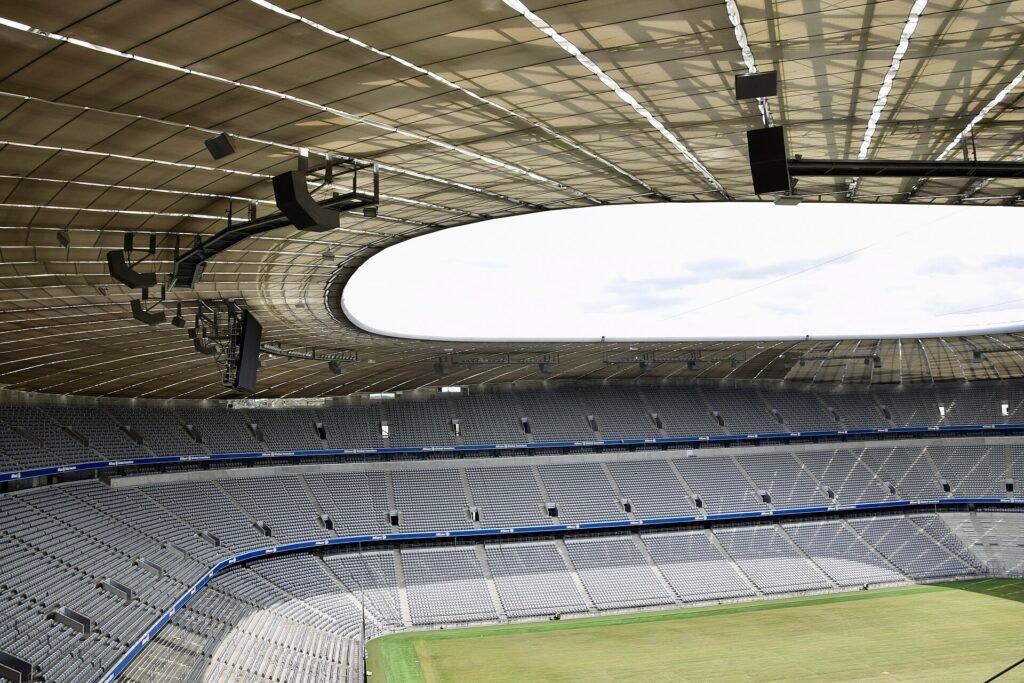
The interior is a three tier bowl with steep sides and no running track, which puts every stand close to the pitch. It feels considerably more compact than 75,000 seats would suggest, and that is the result of good design rather than an accident. The sightlines are excellent from essentially every position. There are no supporting pillars, the rake is steep enough that the upper tier looks down clearly on the play, and the roof covers all the seating. The seats are a reasonable width with adequate legroom, and the concourses are wide enough that moving around at half time does not become a crush. The whole building was designed in one go rather than extended in stages, and the difference that makes is obvious.
The south stand behind one goal holds the standing terrace for domestic fixtures. It is the loudest part of the ground and the cheapest section to buy into. The standing terrace, known as the “Sudkurve,” is home to Bayern’s most vocal supporters, and it produces an intense atmosphere during league matches. The terrace holds approximately 10,000 standing supporters, and it is one of the largest standing sections in German football. The combination of the steep stands and the passionate supporters creates an atmosphere that is both loud and sustained. The sightlines from the standing terrace are excellent, with no obstructed views and a clear view of the pitch.
The stadium also has excellent accessibility for disabled supporters, with dedicated spaces and facilities in all three tiers. The concourses are wide and well signposted, and the facilities are modern and clean. The stadium has several restaurants and bars, which offer a range of food and drink options. The food and drink are reasonably priced by European standards, and the quality is good. The stadium also has a large megastore, which sells a wide range of Bayern Munich merchandise, including shirts, scarves, hats, and other accessories. The megastore is one of the largest club shops in Europe, and it is popular with visitors from around the world.
The Standing Section and European Nights
As at other German grounds, the terrace converts to seating for European competition because UEFA does not permit standing. Capacity drops accordingly and the atmosphere changes with it. This produces the same counterintuitive advice that applies at Dortmund. If the standing section is what you want to experience, book a Bundesliga fixture rather than a Champions League tie. The Munich terrace is smaller than Dortmund’s and does not dominate the ground in the same way, so the difference between league and European atmosphere here is less dramatic than at Signal Iduna Park. It is still noticeable.
The standing terrace is one of the cheapest sections in the stadium, with tickets costing around €15-25 for a domestic league match. The terrace is also one of the most popular sections, and it sells out quickly for big matches. To get a ticket in the standing terrace, you need to become a club member. Membership costs around €60 per year, and it gives you priority access to tickets before they go on sale to the general public. Members can purchase standing tickets for as little as €15, while non-members typically pay €25-30 for the same tickets. The club also offers a “Bayern Ticket” scheme for away supporters, which provides discounted tickets for visitors from other clubs.
The Atmosphere: Good but Not Great
The Allianz Arena produces a good atmosphere without being among the very loudest grounds in Europe, and it is worth explaining why. The design is right. The bowl is enclosed, the roof traps sound, the stands are steep and close to the pitch, and there is a concentrated standing section. Those are the ingredients that produce noise. The limiting factor is the football. Bayern Munich have dominated German football for a sustained period and win a large proportion of their home fixtures comfortably. A crowd that expects to win and then does win by three goals has less to respond to than a crowd watching a tight contest, and the second half of routine league games can go quiet as a result.
For a match against a genuine rival, or a European knockout tie, the ground is loud. The ingredients are all there and they show when the fixture demands it. The best matches to experience the full Allianz Arena atmosphere are home games against Borussia Dortmund, RB Leipzig, or Bayer Leverkusen. These fixtures produce the highest noise levels and the most intense visual displays. The club also organises choreography for big matches, with the Sudkurve producing tifo displays that cover the entire stand. If you are planning a visit, book a ticket in the south stand for the full experience, or in one of the adjacent stands for a view of the atmosphere from the side.
The atmosphere at the Allianz Arena is generally good, but it does not reach the intensity of some other European stadiums, particularly during routine league matches. The crowd is knowledgeable and engaged, but it can be quiet during the second half of one-sided games. On big occasions, such as Champions League nights or derby matches against Borussia Dortmund, the atmosphere can be electric. The Sudkurve is the most vocal section, and it produces an intense atmosphere during high-stakes matches. The ground is also one of the most accessible in European football, with the city centre just a short walk away.
Food, Drink, and the Payment System
The ground operates a cashless top up card system. You load money onto a card and use it for everything inside, and you can normally reclaim the unused balance before leaving. This catches visitors out regularly, so sort it out as soon as you get in rather than when you are hungry. The card can be purchased at several locations throughout the stadium, and it can be topped up using cash or card. The card is also reusable, so you can keep it for future visits. The system is efficient and reduces queues, but it can be confusing for first-time visitors. The club has improved the system in recent years, with more top-up locations and clearer signage.
Prices are reasonable by European standards and dramatically cheaper than English grounds. Beer and food both cost noticeably less than you would pay at a Premier League fixture, and the quality is decent. A beer costs around €4, a bratwurst around €3.50, and a pretzel around €2.50. The stadium has several restaurants and bars, which offer a range of food and drink options. The food and drink are reasonably priced by European standards, and the quality is good. The stadium also has a large megastore, which sells a wide range of Bayern Munich merchandise, including shirts, scarves, hats, and other accessories. The megastore is one of the largest club shops in Europe, and it is popular with visitors from around the world.
Service is efficient and the queues move. German stadium operations tend to be well organised and this one is no exception. The concourses are wide and well signposted, and the facilities are modern and clean. The stadium has several toilets, which are clean and well maintained. The stadium also has several baby changing facilities, which are popular with families. The stadium is fully wheelchair accessible, and there are dedicated spaces for disabled supporters in all three tiers. The stadium also has a sensory room for supporters with autism, which is a great initiative.
Getting There and Away: Transport and Access
The U6 underground line runs to Frottmaning station, from which it is a walk of around fifteen minutes to the ground along a dedicated route. This is the standard way in and it is simple and reliable. The journey from central Munich takes around twenty minutes on the underground, and the ticket often includes local transport on matchday, which removes the cost entirely. The U6 line runs every five to ten minutes during peak hours, and it is one of the most reliable transport options in Munich. The walk from Frottmaning station is well signposted, and it takes you through a park and along a dedicated path to the stadium. The approach view of the stadium is one of the best in European football, and it is worth doing in daylight on a first visit even if the match is in the evening.
Leaving is busy, as it is anywhere with 75,000 people departing simultaneously, but the station handles high volumes and the crowd moves steadily. Allow extra time and do not expect to board the first train. The U6 line runs frequently after the match, and it is usually possible to get a train within ten to fifteen minutes. The journey back to central Munich takes approximately twenty minutes, and it is one of the most reliable transport options in the city. Driving is possible with a large car park attached to the ground, but the roads around it congest heavily afterwards and public transport is the better option. The car park costs around €10-15, and it fills up quickly on matchdays.
The stadium is also accessible by bus, with several routes stopping nearby. The number 690 bus runs from the city centre to the stadium, and it is a good option for visitors who are staying in the northern part of Munich. The stadium is located in the Frottmaning district of Munich, and the surrounding area has several restaurants and bars that are popular with fans before and after matches. The area is relatively quiet on non-matchdays, but it comes alive on matchdays with Bayern Munich supporters. The stadium is also within walking distance of the Allianz Arena S-Bahn station, which is on the S1 and S8 lines. The S-Bahn is a good option for visitors who are staying in the eastern or western parts of Munich.
Ticket Pricing and Booking
Bayern tickets are cheap relative to the standard of football, and the club has publicly defended low pricing for years on the basis that football should remain accessible. Standing tickets in the south stand are the cheapest option and represent excellent value. Seats cost more than the terrace but still sit far below English prices. Adult tickets for standing terrace seats typically cost between €15 and €25, while seated tickets start at around €30-40. Season tickets are even cheaper, with the cheapest options costing around €200 for the entire season. The club also offers discounted tickets for children, seniors, and disabled supporters, making it one of the most accessible clubs in Europe.
Availability is the harder part. Bayern have a very large membership and a long season ticket waiting list, so general sale tickets are limited and sell quickly. Buy through the official club website and avoid resale platforms, since German clubs invalidate tickets sold through unauthorised channels. The club offers a Bayern Munich Membership scheme that provides priority access to tickets before they go on sale to the general public. The membership costs €60 per year and is worth it if you plan to attend more than two matches per season. The club also offers a “Bayern Ticket” scheme for away supporters, which provides discounted tickets for visitors from other clubs.
The club also offers a hospitality package that includes tickets, food and drink, and access to a private lounge. The hospitality package costs between €150 and €300 per person, depending on the category of the match. The club also offers a “Bayern Experience” package that includes the tour, a meal, and a match ticket, which is good value if you want the full Allianz Arena experience. Book as early as possible, as tickets for big matches sell out within hours of going on sale. The club also offers a “Last Minute Ticket” scheme for selected matches, which provides discounted tickets for matches that have not sold out.
The Tour and Museum: A World-Class Experience
The stadium tour is combined with the Bayern Munich museum, which is one of the largest club museums in Europe. The tour covers the dressing rooms, the tunnel, pitchside and the media areas, and explains the engineering of the panel exterior. The museum covers the club’s domestic dominance, its European record and its history through the twentieth century. Both are well presented and the combined ticket is good value. Tours run on most non-matchdays, and they are available in English, German, Spanish, French, Italian, Portuguese, Arabic, Chinese, and Japanese. The audio guide is included in the tour price and provides detailed commentary on the club’s history, the architecture of the stadium, and the famous matches that have been played here.
The tour takes approximately seventy-five to ninety minutes, and it is suitable for visitors of all ages. The club also offers a “Family Tour” that is designed for children, with interactive activities and a simplified commentary. The family tour is available on selected days, and it must be booked in advance. The museum is one of the most comprehensive club museums in Europe, and it includes original match-worn shirts, trophies, photographs, and video footage from the club’s most famous matches. The museum also has several interactive displays, which allow you to test your skills against virtual opponents and relive famous goals and moments from the club’s history.
For anyone visiting Munich who cannot get a match ticket, or who is only offered a low profile league fixture, the tour is a genuinely good alternative rather than a consolation. Book a specific time slot online, particularly in summer when it is extremely busy. The tour is one of the most popular attractions in Munich, and it sells out quickly during peak season. The club also offers a combined ticket that includes the tour and a meal at one of the on-site restaurants, which is good value if you plan to eat at the stadium anyway. The tour is wheelchair accessible on most of the route, and the museum is fully accessible for visitors with mobility impairments.
What a Matchday in Munich Looks Like
Bayern matchdays have a settled rhythm and knowing it makes the day considerably easier, particularly if you are travelling from outside Germany. The city centre fills with supporters from the middle of the day, with Marienplatz and the surrounding beer halls busy well before kick off. Unlike England, where the drinking tends to happen close to the ground, in Munich a lot of it happens in the centre and people travel out together later. The U6 line becomes busy roughly ninety minutes before kick off, and travelling earlier than that is far more comfortable. The walk from Frottmaning station follows a raised path that gives you the approach view of the stadium, which is worth doing in daylight on a first visit even if the match is in the evening.
Inside, the concourses open well before kick off and people use them properly rather than arriving at the last minute. Because service is quick, there is no particular advantage in getting in early beyond enjoying the building. At full time the walk back to Frottmaning is slow but orderly, and trains run frequently. Expect around forty minutes door to door back into the centre once you factor in the queue. The matchday experience at the Allianz Arena is one of the most organised and efficient in European football, and it is a great introduction to German football culture.
The area around the stadium has several pubs and restaurants that are popular with fans before and after matches. The most popular is the “Allianz Arena Biergarten,” which is located within the stadium complex and offers a range of food and drink options. The Biergarten is a great place to meet other supporters before the match, and it is a good option for families. The area is relatively quiet on non-matchdays, but it comes alive on matchdays with Bayern Munich supporters. The stadium is also within walking distance of the Frottmaning S-Bahn station, which is on the S1 and S8 lines. The S-Bahn is a good option for visitors who are staying in the eastern or western parts of Munich.
Combining the Match with a Trip to Munich
Munich works well as a football weekend because the ground is close enough to reach easily but far enough out that it does not dominate the city. The stadium is on the northern edge, around twenty minutes from the centre by underground, so you can spend the day in the city and travel out in the evening without a complicated journey. If you are staying more than one day, the museum and tour are worth doing separately from the match rather than trying to fit both into the same afternoon, since tours do not run on matchdays anyway. The city is also home to a second club, 1860 Munich, who shared the Allianz Arena for several years before returning to the Grunwalder Stadion, a much smaller and older ground in the south of the city. For anyone who wants a completely different kind of German football experience, that is an interesting and very cheap alternative.
Munich is also a great city for football tourists, with several other attractions related to the sport. The German Football Museum is located in Dortmund, but Munich has several other football-related attractions, including the Bayern Munich museum and the Allianz Arena tour. The city is also home to several other sports teams, including the Munich Ravens (American football) and the EHC Red Bull Munich (ice hockey). The city is a great base for exploring the rest of Bavaria, with several day trips available to nearby attractions such as Neuschwanstein Castle and the Bavarian Alps.
How the Allianz Arena Compares to Other European Stadiums
Against Signal Iduna Park, the Allianz Arena has better facilities and is easier to visit. Dortmund has the larger terrace and the stronger atmosphere. Both are excellent value compared with England. The Allianz Arena is one of the most comfortable stadiums in Europe, with wide concourses, excellent sightlines, and a range of food and drink options. The atmosphere at the Allianz Arena is generally good, but it does not reach the intensity of Signal Iduna Park during routine league matches. On big occasions, such as Champions League nights or derby matches against Borussia Dortmund, the atmosphere can be electric.
Against Old Trafford or Anfield, the Allianz Arena is more modern and has better facilities. Old Trafford and Anfield both have a more traditional feel, with narrower concourses and older facilities. But the Allianz Arena has better accessibility, better sightlines, and a more central location. If atmosphere is your priority, Old Trafford or Anfield are the better choices. If facilities and accessibility are your priority, the Allianz Arena is the better choice.
Against Tottenham Hotspur Stadium, the two are comparable on facilities, with the Allianz Arena considerably larger and more centrally located. The Tottenham Hotspur Stadium is one of the most modern stadiums in England, but it is located in north London, which is less convenient than the Allianz Arena’s location in Munich. Both stadiums have excellent tours, but the Allianz Arena’s museum gives it a significant advantage. If you are visiting London and Munich, both stadiums are worth seeing, but the Allianz Arena offers a more complete experience.
Tips for a First Visit
Book a Bundesliga fixture if you want the standing terrace, since it converts to seats for European matches. The standing terrace is one of the cheapest sections in the stadium, and it is one of the most popular sections. Arrive before dark if possible, or stay to see the exterior lit up afterwards. The lighting is a genuine part of the experience, and it is one of the most distinctive features of the stadium. Sort out the payment card immediately on entry rather than waiting until half time. The card can be purchased at several locations throughout the stadium, and it can be topped up using cash or card.
Check whether your ticket includes local transport, as it usually does. The U6 line runs every five to ten minutes during peak hours, and it is one of the most reliable transport options in Munich. Buy only through the official club website. Munich is a major tourist destination, and there is an active market in overpriced and unreliable tickets aimed at visitors. Allow around forty minutes for the journey back to central Munich after the match. The U6 line runs frequently after the match, and it is usually possible to get a train within ten to fifteen minutes.
Book the tour if the only available fixture is a minor league game. The museum is the strongest part of the whole experience, and it is worth the price of admission even if you cannot get a match ticket. The tour is available on non-matchdays, and it is a great way to learn about the club’s history and the architecture of the stadium. Use the Frottmaning S-Bahn station rather than the U6 station on the way out to avoid the worst of the crowd. The journey takes approximately five minutes longer, but it is usually faster than waiting at Frottmaning station.
Overall Verdict
The Allianz Arena is modern, comfortable, well run, easy to reach and genuinely good value. For a first trip to a major European ground it is close to the ideal choice, because nothing about the day is difficult. The stadium is a masterpiece of modern engineering and design, and it has become one of the most recognisable landmarks in Germany. The exterior alone is worth the trip, and the interior is one of the most comfortable and well-designed stadiums in Europe.
The atmosphere is good rather than exceptional, and the reason is the football rather than the building. When Bayern face a real challenge the ground responds properly. The standing terrace is one of the best in German football, and it produces an intense atmosphere during league matches. The sightlines are excellent throughout the stadium, with no obstructed views and a consistent rake that ensures even the highest seats have a good angle on the pitch. The roof covers all seats, which is a significant improvement over older stadiums where weather could be a factor.
See it at night if you can, book a league fixture for the terrace, and sort out the payment card early. On those terms it is one of the most enjoyable stadiums in Europe to visit. The Allianz Arena is not just a stadium — it is a landmark, a museum, and a symbol of one of the greatest clubs in football history. Whether you are a Bayern Munich supporter or simply a football fan, it is a destination that rewards a visit.
📚 From the Blog
Image credit: Ank Kumar / Wikimedia Commons (CC BY-SA 4.0)