
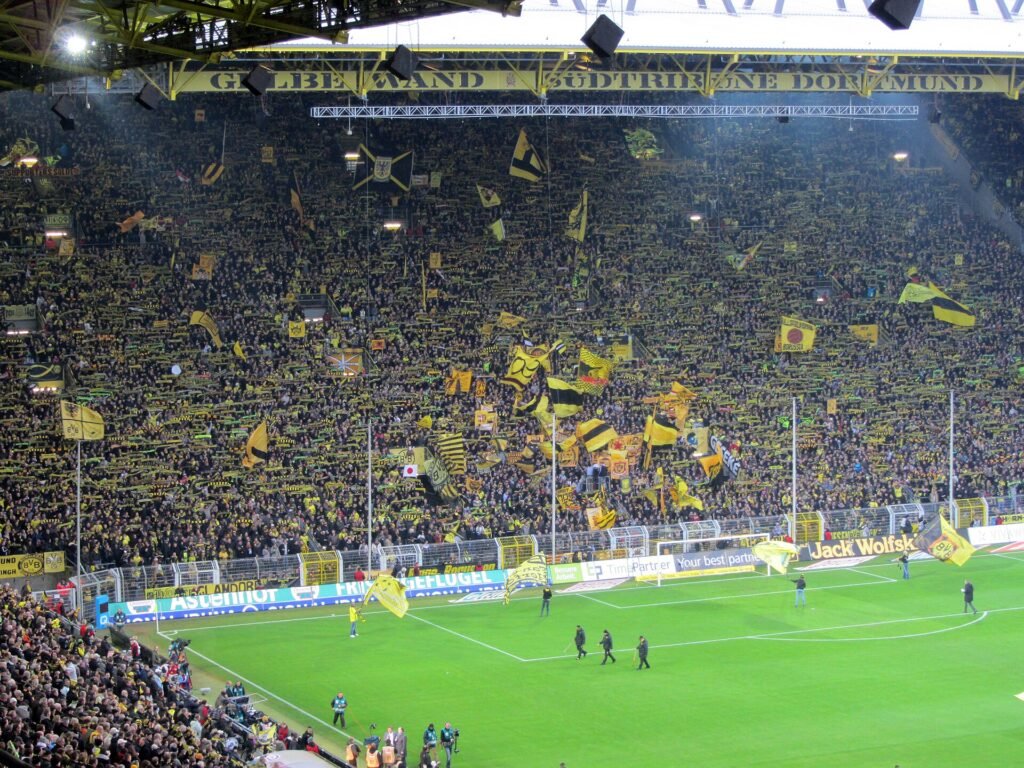
Borussia Dortmund’s south terrace is routinely called the loudest stand in world football, and unlike most stadium superlatives, this one has actually been tested. Acousticians and broadcasters have measured crowd noise inside Signal Iduna Park at over 130 decibels, a level closer to a jet engine at close range than to a football match, and the terrace responsible for it holds 25,000 people standing shoulder to shoulder with nowhere else in Europe offering anything close.
That single feature, known as the Sudtribune or the Yellow Wall, defines almost everything about visiting this ground. It is the reason neutrals travel across the continent for a routine Bundesliga fixture, and it is the reason a single rule about European competition can turn what sounds like the same match into a completely different experience.
This review sets out what the Yellow Wall is actually like to stand in, why Champions League nights here can be quieter than domestic ones, what the ground gets right beyond the noise, and the practical details, from the payment card system to the exact timing of a good terrace position, that make or break a visit.
Quick Facts: Signal Iduna Park at a Glance
| Feature | Details |
|---|---|
| Capacity (domestic) | 81,365, including the standing terrace |
| Capacity (European) | Around 66,000, terrace converted to seating |
| Opened | 1974 as Westfalenstadion, renamed 2005 |
| Home Team | Borussia Dortmund |
| The Yellow Wall | Sudtribune, roughly 25,000 standing capacity |
| Nearest Transport | Stadion stop, Dortmund U-Bahn |
| Cheapest Terrace Ticket | Around €15-20 |
| Payment System | Cashless top-up stadium card |
The capacity gap in that table is the single most important fact in this review. UEFA does not permit standing at European matches, so the terrace becomes seated for the Champions League and the crowd drops by roughly fifteen thousand. A domestic league fixture, not a European night, is the one to book if the terrace is the reason for your trip.
Why the Yellow Wall Sounds the Way It Does
Understanding the physics helps explain why nowhere else in Europe reproduces this. Standing sections behave completely differently from seated ones acoustically. A seated crowd is separated by armrests and rows, and each person’s voice disperses somewhat independently. A packed standing terrace moves and breathes as one mass, and the sound compresses and reflects between thousands of closely packed bodies before it escapes.
The terrace also rises at a notably steep angle, closer to the pitch than most seated stands manage, which concentrates the sound source and directs it downward rather than losing it upward into open air. Combine the density, the steepness and the sheer scale, and you get a noise source unlike anything a seated 25,000-capacity stand could produce, however loud the individual voices.
Germany Never Removed Standing Terraces
England abolished large standing terraces after the Hillsborough disaster in 1989 and the Taylor Report that followed, converting every top-flight ground to all-seater. Germany took a different regulatory path, retaining standing sections under strict modern safety rules including capacity limits, crush barriers and dedicated stewarding designed specifically for crowd density at this scale.
That divergence, decades old now, is the entire reason a ground like this exists in Germany and nowhere in English football. Safe standing has recently returned to a handful of English grounds, but nothing there approaches 25,000 people in one continuous block, and it is unlikely to for a long time given the size of the sections involved.
From Westfalenstadion to a Renamed, Redeveloped Ground
The stadium opened in 1974 as the Westfalenstadion, built for that year’s World Cup in West Germany, and it began life holding a fraction of its current capacity. Expansion came in stages rather than a single rebuild: a second tier was added in the 1990s, and the ground was substantially enlarged again ahead of the 2006 World Cup, which Germany hosted, pushing capacity toward the 80,000-plus figure it holds today.
The current name arrived in 2005 through a naming rights deal with the insurance company Signal Iduna, a common arrangement in German football that nonetheless remains controversial among a section of supporters who still refer to the ground by its original name in conversation and in older club material. Both names are used interchangeably by locals, and a visitor will encounter each depending on who they ask.
The 2006 World Cup expansion is what gave the stadium its current profile among the largest club grounds in Europe, and it is worth knowing that the famous Sudtribune terrace predates that expansion considerably, meaning the wall of noise associated with the ground today has been a fixture of matchdays here for far longer than the stadium’s current overall size.
Matches That Have Tested the Sudtribune’s Reputation
The 2013 Champions League semi-final against Real Madrid, played with the terrace converted to seating under European rules, still produced a noise level that Real Madrid’s own players described afterwards as unlike anything they had experienced, a rare instance of the seated European configuration matching the reputation built on domestic standing nights. Dortmund won that leg 4-1, and the atmosphere is widely credited by both sets of supporters as having affected the visiting team’s composure.
Domestic derbies against Schalke, known as the Revierderby and contested between clubs separated by barely a fifteen-minute drive within the same industrial region, regularly produce a version of the Yellow Wall considered even more intense than a routine European night, since the rivalry carries a local weight that a continental fixture, however prestigious, cannot fully replicate.
Buying a Terrace Ticket
Getting onto the Sudtribune is harder than the ticket price suggests, because demand vastly exceeds the tickets available to anyone outside the club’s membership structure. Most terrace tickets go to season ticket holders and members with a strong purchasing history, and general sale for a fixture with any profile at all typically sells out within minutes.
Buy only through the official Borussia Dortmund website. Unofficial resale is treated seriously by German clubs and tickets identified as resold through unauthorised channels are frequently cancelled. Seated tickets, while lacking the terrace experience directly, are considerably more obtainable for a visitor and still place you inside a ground where the Wall’s noise carries across the whole bowl.
A membership scheme exists specifically to improve access over time, rewarding attendance history with earlier and wider sale windows, and it is worth considering for anyone planning more than one visit to German football.
Arriving Early Actually Matters Here
Unlike most stadiums, where an early arrival is simply convenient, on the Sudtribune it materially changes your experience. The terrace fills from the front, and position is entirely first-come. Arrive an hour before kick-off and you are near the barrier with a clear view. Arrive fifteen minutes before and you are standing at the very back, seeing far less and hearing the noise from behind rather than being inside it.
The city centre fills with yellow from early afternoon on matchdays, and a significant part of the occasion happens there before anyone reaches the ground. Trams towards the stadium become tightly packed roughly ninety minutes before kick-off, so travelling earlier than that is considerably more comfortable and, importantly, your ticket typically includes the tram fare within the region on matchday.
The Cashless Card System
Every food and drink purchase inside the ground runs through a stadium top-up card rather than cash or an ordinary bank card. You load money onto the card at a kiosk when you arrive, then use it at every counter inside. This catches almost every first-time visitor out, and the sensible move is to sort it out the moment you enter rather than at half time, when the loading points have long queues.
Any balance left on the card at the end of the day can usually be refunded at the same machines before you leave, and it is worth the two minutes it takes so those last few euros are not simply lost. Food and beer prices are noticeably lower than at Premier League grounds, which adds a real saving on top of already cheap tickets.
How Prices Compare and the 50+1 Rule Behind Them
The cheap tickets that define a visit here are not an accident of one club’s generosity but a structural feature of German football regulation known as the 50+1 rule, which requires member clubs to retain majority voting control over their own football operations even where outside investors hold financial stakes. That structure gives club members real influence over decisions including pricing, in a way that shareholder-controlled English clubs do not replicate.
Borussia Dortmund’s own membership runs into six figures, among the largest of any football club anywhere, and that scale of ownership is part of why ticket prices have stayed low relative to the club’s sporting success, including regular Champions League participation and a Bundesliga title as recently as 2011-12. A seat comparable in view and proximity to a mid-priced English Premier League ticket typically costs a fraction of the price here.
This pricing structure extends to food and drink inside the ground, where a beer and a bratwurst together often cost less than a bottle of water at some English stadiums, a detail that consistently surprises first-time visitors from Britain more than almost anything else about the trip.
What the Rest of the Ground Is Like
The Yellow Wall dominates any description of this stadium, but the other three sides are a well-designed football ground in their own right. All four stands are enclosed with steep tiers and no running track, which means every seat sits close to the pitch and sightlines are clear throughout, unlike the older English grounds with pillared obstructions.
The north stand holds away supporters and is entirely seated. The east and west stands run along the sides and offer the best central views of the pitch, elevated enough to read the shape of the game clearly. Facilities across the ground are functional and efficient, plain but well run, in keeping with the value-focused pricing that runs through the whole operation.
Away Fixtures and European Nights
For a Champions League or Europa League tie, plan for a different atmosphere from the one the ground is famous for. The terrace converts to seating, capacity falls to around 66,000, and while the noise is still considerable by most stadiums’ standards, it does not reach the intensity of a full standing Sudtribune on a domestic Saturday.
This produces advice that runs against instinct at almost every other stadium in Europe, where the biggest continental nights are usually the best fixtures to attend. Here, an ordinary Bundesliga match against mid-table opposition, with the terrace at full capacity, delivers more of what people travel for than a Champions League knockout tie does.
Combining the Trip With the Rest of the Ruhr
Dortmund sits within one of the densest concentrations of professional football anywhere in Europe. Schalke, Bochum and several other clubs all play within roughly an hour by train, and because German fixtures spread across Friday evening through Sunday afternoon, attending two matches in a single weekend is realistic in a way it rarely is in England.
The German Football Museum sits near Dortmund’s main station and is worth an hour if you are staying more than a day. The city itself is inexpensive by western European standards, which keeps the total cost of a football weekend here well below an equivalent trip built around a single Premier League fixture.
Where This Ground Sits Among Germany’s Biggest
Dortmund’s capacity is the largest in Germany and among the largest in Europe, ahead of Bayern Munich’s Allianz Arena and every English ground bar Wembley and Old Trafford, a scale that surprises visitors who associate Bundesliga football with smaller, more intimate stadiums. That size, combined with the standing terrace, produces a specific kind of atmosphere that even Bayern’s own well-regarded home cannot quite replicate, since Munich’s terrace section is considerably smaller by comparison.
Accessibility provision has improved substantially over recent renovations, with wheelchair positions available across multiple levels and lift access to the upper tiers, though as with most European grounds it is worth contacting the club in advance to confirm current arrangements for a specific fixture rather than assuming standard provision applies.
For anyone building a broader trip around the visit, Dortmund’s location within the Ruhr valley puts several other Bundesliga grounds within an hour by train, and German football’s Friday-to-Sunday fixture spread makes combining two matches in one weekend possible in a way that rarely works with the tighter Saturday-Sunday scheduling common in England.
What Away Supporters Say About Playing Here
Bayern Munich, despite being Dortmund’s closest domestic rival for the Bundesliga title across the last decade, have repeatedly had players and coaching staff acknowledge the difficulty of the away trip to Signal Iduna Park specifically because of crowd noise rather than any tactical factor, a rare instance of one elite club publicly crediting an opponent’s stadium as a real competitive factor. International visitors from England’s Premier League clubs, on the rare occasions they have played here in European competition, have offered similarly consistent testimony.
This reputation has made the ground something of a pilgrimage site for football supporters with no connection to either Dortmund or any specific opponent, arriving purely to experience the atmosphere as neutrals, a pattern the club has embraced, not fought against, since it has helped build Dortmund’s international profile well beyond its domestic trophy count.
Local supporters generally welcome visiting neutrals warmly provided basic etiquette is observed, including not wearing rival club colours in the home sections and and respecting the terrace’s standing and singing traditions instead of treating it purely as a spectacle to film on a phone throughout the match.
Tips for a First Visit
Book a domestic Bundesliga fixture rather than a European tie if the terrace itself is the goal. Buy only through the official club channel and consider membership if you expect to return. Arrive at least an hour before kick-off if you have a terrace ticket, since position is earned by arriving early rather than assigned.
Sort out the payment card the moment you enter, and reclaim any balance before you leave. Dress for the weather: German winters here bite hard and you are standing outdoors for the full match with no seat to sit and rest in. If you cannot get a terrace ticket, take a seated one anyway; the noise from the Wall reaches every part of the ground.
How It Compares to Other European Grounds
Against the Allianz Arena, Bayern Munich’s home and Germany’s other major stadium, Dortmund wins clearly on raw atmosphere thanks to the scale of the standing terrace, though Munich offers a more comfortable, modern facility overall and its own smaller standing section. Against English grounds, the comparison is not close on price or noise: nothing in the Premier League offers anything approaching 25,000 people standing together, since safe standing sections introduced in England remain far smaller in scale.
Against Celtic Park, another ground built substantially on reputation for noise, Dortmund’s advantage is size and structural design specifically built around a standing terrace, while Celtic’s comes more from a fully enclosed roof and a smaller, more concentrated crowd. Both rank among the loudest grounds in Europe, arrived at through different architectural routes, and either is worth the trip for broadly the same reason.
What a Full Matchday Looks Like
Supporters arriving from central Dortmund typically spend the early afternoon in the city’s main square and surrounding bars, where the walk to the stadium along Strobelallee becomes its own kind of procession as the crowd swells and the yellow shirts multiply. This build-up is treated as part of the occasion, not simply the journey to it, and many visitors deliberately allow two to three hours before kick-off purely to experience it.
Inside the ground, the Sudtribune begins its pre-match chanting well before the teams appear, a tradition distinct from the reactive noise most stadiums produce only after something happens on the pitch. By the time the players walk out, the terrace is already at a volume many first-time visitors describe as startling, having expected the noise to build gradually through the match rather than arrive at near-full intensity from the opening whistle.
Overall Verdict
Signal Iduna Park is worth the trip for one reason that no other European ground can currently match at this scale: a 25,000-strong standing terrace producing noise that has actually been measured and found to be extraordinary. Everything else about the visit, from the cheap tickets to the cashless card to the well-organised concourses, is a well-run German football ground doing the basics properly.
Choose the right fixture, arrive early enough to earn a good position, and treat the domestic league game rather than the European tie as the priority. Get that right and this remains one of the most worthwhile football trips available anywhere in Europe.
📚 From the Blog
Image credit: Markus Unger from Vienna, Austria / Wikimedia Commons (CC BY 2.0)