
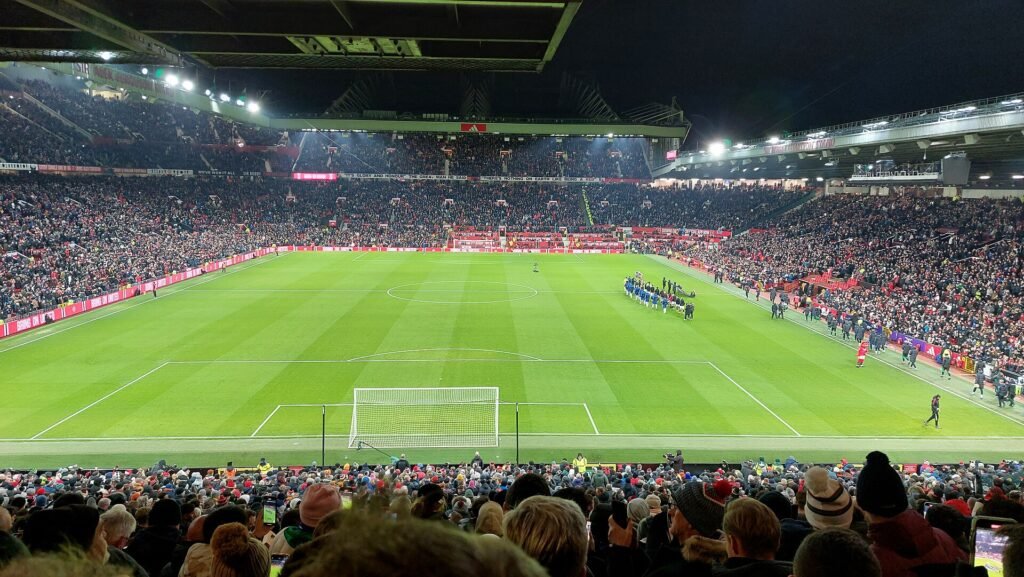
A supporter who books the front row at Old Trafford expecting the best seat in the house is, more often than not, disappointed within the first ten minutes. The pitch is level with your eyeline, the far side of the field disappears behind the players nearest you, and the advertising hoardings cut off your view of anything happening near the touchline in front of you. The best seat in a 74,000-capacity stadium is rarely the closest one, and understanding why is the whole point of this guide.
Old Trafford’s four stands vary enormously in height, age and viewing quality, a legacy of a ground extended in uneven stages across more than a century rather than built to a single design. Some sections offer an excellent view for a modest price. Others, priced identically or even higher, sit behind a supporting pillar that blocks a meaningful portion of the pitch for the full ninety minutes.
This guide works through every major stand and tier, explains which specific blocks carry restricted views and why, compares price against what you actually see, and sets out where families, first-timers and supporters chasing atmosphere should each be looking when they book.
Quick Comparison: Old Trafford Seating at a Glance
| Area | View Quality | Atmosphere | Relative Price |
|---|---|---|---|
| Sir Alex Ferguson Stand, Upper Tier | Excellent | Moderate | Mid-range |
| Stretford End, Lower Tier | Good (behind goal) | Highest | Mid-range |
| Sir Bobby Charlton Stand | Variable, some restricted | Moderate | Lower |
| East Stand (family section) | Good | Family-friendly | Discounted for juniors |
| Sir Alex Ferguson Stand, Lower Tier | Very good, closest to pitch | Moderate | Highest |
As that table shows, the priciest seats are not automatically the best for actually following the match. The upper tier along the side consistently rates highest for pure viewing quality among experienced visitors, while proximity to the pitch trades away your sense of the game’s overall shape.
The Sir Alex Ferguson Stand: The Best Seat in the Ground
This three-tier stand runs the full length of one side and is where most reviewers, staff and experienced supporters point first-time visitors. The lower tier sits closest to the pitch and gives an intimate, pitch-level sense of the game’s pace, though the angle here compresses the far touchline and makes reading the overall shape of play difficult.
The upper tier is the section worth paying attention to. Elevated well above the pitch with a steep rake, it offers a clear view of the entire playing surface, allowing you to see formations, off-the-ball movement and tactical patterns that are simply invisible from a lower seat. Prices here sit in the mid-range for the stand overall, making it arguably the best value combination of view and cost anywhere in the ground.
Restricted View Warning: The Older Sections
Parts of this stand, particularly toward its older ends where earlier construction phases meet newer ones, retain supporting pillars from a rebuild era before cantilever roof engineering became standard. Seats directly behind these pillars can lose sight of one goal entirely for the full match. Always check the specific block description when booking, since the club does mark restricted-view seats but the discount does not always reflect how severe the obstruction actually is.
The Stretford End: Atmosphere Over Sightline
This is the traditional home end and the source of the loudest, most sustained singing in the ground, particularly in the lower tier. If your priority is being part of the noise rather than analysing the tactics, this is where to book, and the corner where it meets the Sir Alex Ferguson Stand offers a reasonable compromise between the singing and a workable angle on the pitch.
The trade-off is standard for any seat directly behind a goal: you lose depth perception on the far side of the pitch, and the goal closest to you can feel oddly compressed since the action happens almost directly beneath you rather than spread across your field of view. Supporters here also tend to stand for long periods regardless of the all-seater rules, which is worth knowing if standing for an extended time is uncomfortable for you.
The Sir Bobby Charlton Stand: Cheapest, But Check Carefully
Facing the Ferguson Stand across the pitch, this stand is lower because a railway line running immediately behind it has permanently capped how far it can be expanded. That constraint is also why prices here tend to sit below the equivalent tier on the opposite side, making it attractive for budget-conscious visitors.
The catch is that this stand contains some of the ground’s most persistent restricted-view seats. Older sections here were built before cantilever roofing removed the need for pillars, and the discount applied to affected seats does not consistently match the severity of what you will actually experience. A seat marked restricted here can mean losing an entire third of the pitch behind a steel column for ninety minutes.
What Corner Seats Actually Offer
Corner sections, where the Ferguson Stand meets either the Stretford End or the East Stand, are consistently overlooked by first-time buyers who default to either a pure side seat or a pure behind-the-goal seat without considering the middle ground. A corner seat gives a diagonal view of the pitch that retains some sense of depth on both goals while still placing you close enough to a vocal section to feel some of the atmosphere generated there.
Pricing in these corner blocks tends to sit between the two extremes it borders, making it a compromise option rather than simply a lesser version of either side. For a supporter unsure which experience they actually want, particularly on a first visit, a corner seat removes some of the risk of committing fully to one extreme and being disappointed by the trade-off.
The specific corner matters too. The corner nearest the Stretford End carries more of that stand’s noise than the corner nearest the family-oriented East Stand, so a supporter should still think about which side of that compromise they lean toward rather than treating all corner seats as interchangeable.
Height Within a Tier: Front Row Versus Back Row
Beyond which stand and which tier, where you sit within that tier changes the experience considerably. The front row of the upper Ferguson Stand tier sits at the point where the steep rake begins, giving an excellent unobstructed view forward but requiring you to look down at a slightly awkward angle for play happening directly below in the lower tier’s airspace.
The back row of the same tier sits highest and furthest back, trading some sense of proximity for the most complete overhead view of the pitch available anywhere in the stand. Supporters who specifically want to read tactical patterns, the shape of a press, the width a team is playing with, consistently rate the back rows of the upper tier as superior for this purpose precisely because the elevation flattens the pitch into something closer to a tactical diagram.
The very front row of any lower tier, by contrast, is the seat most likely to disappoint a first-time visitor expecting proximity to translate directly into a better view, since the advertising hoardings and the sheer closeness to pitch level combine to obscure more of the game than the ticket price might suggest.
Behind the Goal Versus Along the Side
This is the single most important decision at any football ground, and Old Trafford illustrates it clearly. Seats along the side, particularly elevated ones, let you see both goals, read passing lanes and understand why a team is winning or losing territorial battles. Seats behind the goal put you closer to the crowd’s emotional centre but flatten your sense of the pitch into a single compressed plane.
Neither is objectively correct. A supporter attending primarily to sing and be part of a crowd should book the Stretford End. A supporter attending to study the match, perhaps a first visit where understanding the occasion matters more than the noise, should look at the side stands, ideally elevated, instead.
Family Sections and the East Stand
The East Stand houses ticket offices, the museum entrance and a dedicated family section with discounted pricing for accompanied children. Stewarding here is specifically oriented toward families, language and behaviour standards are more actively enforced than elsewhere, and the sightlines are solid without carrying the restricted-view risk found in the older Charlton Stand sections.
For a first visit with young children, this is consistently the recommended area. The atmosphere is calmer than the Stretford End, seats are typically easier to book together as a group, and proximity to the family facilities and quieter concourses reduces the logistical stress of managing children through a crowd of 74,000.
Away Supporters and Visiting Fans
Away fans are allocated a section within the Sir Bobby Charlton Stand, typically in a corner block, priced under the Premier League’s away-ticket cap regardless of the home club’s own category pricing for that fixture. The view from the away section is workable rather than exceptional, sharing some of the same restricted-view risk present elsewhere in that stand, though the away allocation itself is usually positioned to avoid the very worst of the affected blocks.
Seats to Specifically Avoid
Beyond the general pillar warning already covered, a handful of specific problem areas come up repeatedly in supporter feedback. Certain rows in the older Charlton Stand sections sit close enough to a supporting column that the obstruction covers not just one goal but a meaningful stretch of the near touchline as well, considerably worse than the standard restricted-view warning suggests.
The very back row of the lower tiers, in any stand, tends to sit beneath the overhang of the tier above, which can partially obscure high balls and corners taken near that end, an issue distinct from the pillar problem but useful to knowing about separately since it affects seats that carry no official restricted-view marking at all.
Seats at the extreme ends of the East and West corners, where the stand curves to meet the goal-end sections, occasionally suffer from an awkward viewing angle that neither the behind-the-goal nor the side-on description fully captures, and checking a seat-view photograph before booking anything in these specific corner blocks is worth the extra few minutes it takes.
How Prices Actually Break Down
Manchester United use a category system, meaning the identical seat costs more against a major rival than against a newly promoted side. A lower-category league fixture in the upper Ferguson Stand can cost meaningfully less than a high-category derby seat in a supposedly cheaper section of the Charlton Stand, which makes fixture choice as important as seat choice when trying to balance cost against view quality.
Membership improves access to general sale but does not change the underlying category pricing structure. For a visitor prioritising value, targeting a lower-category fixture in the upper Ferguson Stand consistently delivers the strongest combination of view and price available anywhere in the ground.
Comparing the Cost of a Good View to a Cheap Seat
The price gap between the best-value upper Ferguson Stand seats and the cheapest available restricted-view seats in the Charlton Stand is often smaller than supporters assume, sometimes as little as the cost of a matchday programme and a drink. Given that gap, paying slightly more for a confirmed clear sightline is, for most first-time visitors, the better use of money than saving a small amount and risking ninety minutes spent leaning around a pillar.
Where the price difference becomes more meaningful is between general admission and hospitality packages, which include padded seating, in-seat food service and lounge access at a considerable premium. For a supporter attending primarily for the football rather than the wider experience, this premium rarely translates into a proportionally better view, since hospitality tiers sit at broadly the same height and angle as adjacent general admission seats.
A useful rule of thumb that experienced visitors apply is to treat the upper Ferguson Stand as the baseline for value, and only pay a premium above that baseline for a specific reason, whether that is proximity for a particular occasion, a hospitality package for a client or celebration, or a seat in the Stretford End specifically for the atmosphere it is known for.
Tips for Booking the Right Seat
Check the specific block for restricted-view markings before booking anything in the Sir Bobby Charlton Stand or the older sections of the Ferguson Stand, and where the club provides a seat-view photograph, use it rather than relying on the general description alone. If your priority is atmosphere, book the lower Stretford End and expect to stand for long periods. If your priority is understanding the match, book the upper Ferguson Stand and accept a smaller share of the noise.
For families, the East Stand family section remains the most consistently recommended option, offering calmer stewarding and solid sightlines without the pillar risk found elsewhere. Whatever you choose, book a lower-category fixture if value matters more to you than the specific opponent, since the price gap between categories at Old Trafford is often larger than the price gap between seating areas within a single match.
Concourse Facilities: Old Sections Versus the Redeveloped Areas
Not every concourse at Old Trafford was built to the same standard, and that gap matters more during a fifteen-minute half-time window than most first-time visitors expect. The areas behind the East Stand and the newer sections of the Ferguson Stand have wider walkways and more food points per supporter, so queues move at a manageable pace even during a full house.
The older Charlton Stand concourse tells a different story. Built to a narrower footprint decades before modern crowd-flow standards existed, it can back up badly at half-time, particularly for a sold-out derby. A supporter seated there who wants food or a drink is often better off ordering in the opening minutes of the second half rather than waiting for a natural lull, since there is rarely one.
Buying From Other Supporters: The Official Exchange
Manchester United run an official ticket exchange allowing members unable to attend a fixture to resell at face value through a club-controlled platform, and this is consistently the safer route for a visitor hoping to pick up a seat outside general sale. Unofficial resale carries real risk, including tickets tied to membership cards that can be refused at the turnstile if the name does not match, so the club’s own exchange is worth checking before turning to a third-party site.
Availability through the exchange tends to improve for lower-category league fixtures and shrinks sharply for derbies or cup ties against major rivals, following the same demand pattern that shapes general sale pricing across the rest of this guide.
Overall Recommendation
For most first-time visitors balancing view, price and comfort, the upper tier of the Sir Alex Ferguson Stand along the halfway line offers the best overall combination available at Old Trafford. It sits at a moderate price point, avoids every restricted-view risk in the ground, and gives a complete view of the tactical picture that no seat closer to the pitch can match.
Chase the Stretford End specifically if noise and being part of the singing matter more to you than seeing the whole pitch clearly, and always verify the block for pillar obstructions before booking anywhere in the older stands. Old Trafford rewards a visitor who checks the seating map carefully far more than one who simply books whatever appears first at the lowest price.
📚 From the Blog



Image credit: Joris van Rooden / Wikimedia Commons (CC BY-SA 4.0)