
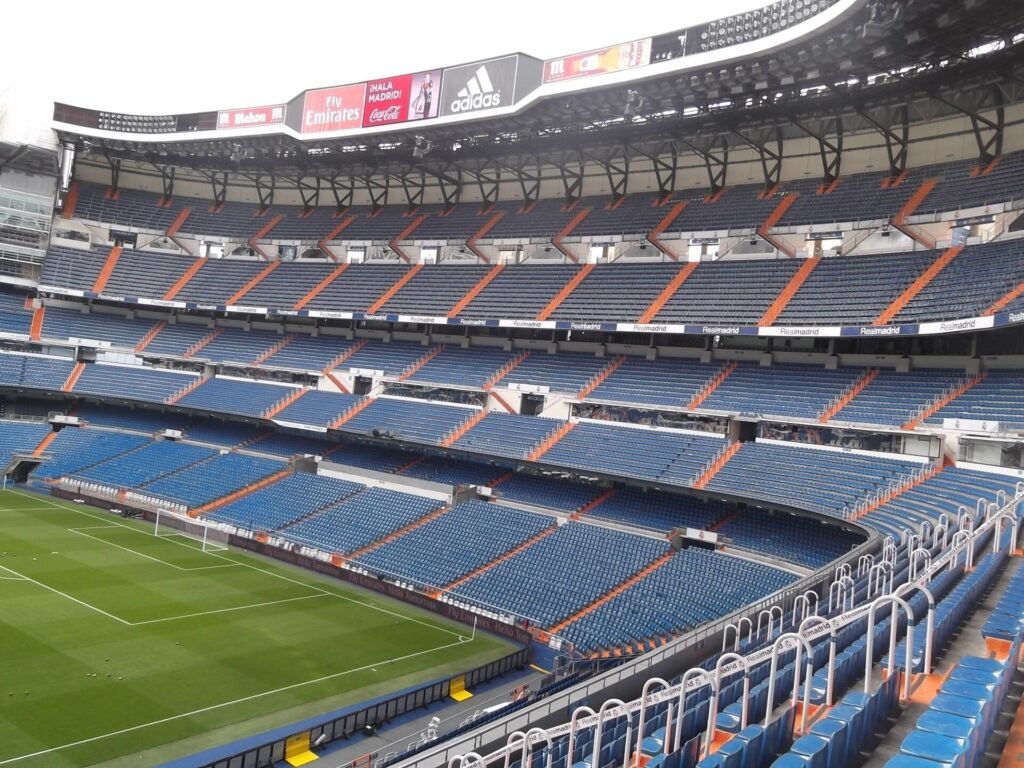
The Santiago Bernabeu has been rebuilt over the last few years and now looks almost nothing like the ground people remember from television in previous decades. The exterior is wrapped in a curved steel shell, there is a retractable roof, and the pitch itself can be lowered below ground level so the building can host concerts and other events without the grass being damaged. The transformation is one of the most ambitious stadium projects ever attempted, and it has fundamentally changed what it means to visit this iconic venue.
It holds around 78,000 people, it is the home of Real Madrid, and it sits in the middle of Madrid on one of the city’s main avenues rather than on the outskirts. That central location is unusual for a ground this size and it makes visiting considerably easier than at most large stadiums. The Bernabeu is not just a football stadium — it is a landmark building that dominates the Paseo de la Castellana, one of the most important thoroughfares in Madrid. Whether you are a Real Madrid supporter, a football tourist, or simply someone interested in architecture and engineering, the Bernabeu is a destination that rewards a visit.
This review covers what the redevelopment actually delivered, what the ground is like to sit in, the long-standing criticism of its atmosphere, and how to plan a visit whether or not you can get a match ticket. We have visited the stadium both before and after the redevelopment, so we can speak to the changes from firsthand experience. The Bernabeu is a ground that has evolved dramatically over its history, and the latest chapter in that evolution is one of the most significant in European football.
One important note: the Bernabeu is not a ground that produces a consistently loud atmosphere for routine league matches. The crowd can be quiet during comfortable home wins, and the tourist share of the attendance is high. But on Champions League nights and against top opposition, the atmosphere transforms into something genuinely special. Understanding this distinction is key to setting the right expectations for your visit.
Quick Facts: Santiago Bernabeu at a Glance
Before diving into the detailed review, here is a quick summary of the key facts about the Santiago Bernabeu. This table covers the essential information you need to know before planning a visit.
| Feature | Details |
|---|---|
| Capacity | ~78,000 |
| Opened | 1947 (redeveloped 2019-2024) |
| Home Team | Real Madrid |
| Location | Paseo de la Castellana, central Madrid |
| Nearest Metro | Santiago Bernabeu (Line 10) |
| Cheapest Ticket | €25-40 (league matches) |
| Tour Price | €25-30 |
| European Cup Finals Hosted | 4 |
As you can see, the Bernabeu is one of the most accessible large stadiums in Europe, with a metro station directly outside and a central location that makes it easy to reach from anywhere in Madrid. The ticket prices are moderate for a club of Real Madrid’s stature, and the tour is one of the most popular attractions in the city. Let us look at each aspect of the stadium in detail.
History and Origins: From Civil War Ruins to European Dominance
The stadium opened in 1947 and was named after Santiago Bernabeu, the club president who drove its construction and who had previously played for and managed the club. It replaced an earlier ground, the Campo de O’Donnell, that had been damaged during the Spanish Civil War. The new stadium was a statement of ambition from a club that was determined to re-establish itself as a force in Spanish and European football. The original capacity was around 75,000, and it was expanded repeatedly through the following decades as Real Madrid grew into one of the dominant clubs in European football.
At various points in its history it held over 120,000 people, in the era when large standing sections were still permitted, before all-seater requirements reduced that considerably. The ground has hosted four European Cup finals and the 1982 World Cup final, which gives it a claim to more major finals than almost any other club stadium in the world. It has also hosted the 1964 European Championship final, the 2010 Champions League final, and numerous other significant matches. The Bernabeu is not just a stadium — it is a stage on which some of the most important moments in football history have played out.
The most recent redevelopment began in 2019 and has run over several years, with the club continuing to play throughout. It is one of the most technically ambitious stadium projects ever attempted, and the cost reflects that. The redevelopment has transformed the Bernabeu from a dated, functional stadium into one of the most modern and versatile venues in the world. The project was designed by the architects GMP Architekten, Fenwick Iribarren Architects, and Ribas & Ribas, and it has been praised for its innovative approach to stadium design.
The Redevelopment: What Changed and Why
The most visible change is the exterior. The ground is now enclosed in a curved shell of steel slats that wraps the entire building, replacing the plain concrete of the old structure. The surface can be used as a display screen, which is unusual on a building of this size. The exterior shell is not just decorative — it is a functional element that helps to regulate the temperature inside the stadium and provides a canvas for visual displays on matchdays. The shell is made of stainless steel and glass, and it is designed to be illuminated at night, creating a striking visual landmark on the Madrid skyline.
The retractable roof closes over the seating and the pitch, which means matches are no longer affected by weather and the building can be used year round for other events. The roof can be opened or closed in approximately fifteen minutes, and it is one of the largest retractable roofs in the world. The roof is supported by a series of steel cables that are anchored to the exterior shell, and it is designed to withstand extreme weather conditions. The roof also helps to trap and reflect sound, which should improve the atmosphere for future matches.
Underneath the pitch is a storage system that allows the grass to be moved below ground in sections. This protects it when the stadium is used for concerts and other non-football events, which is the main commercial justification for the entire project. The pitch can be switched between football and entertainment configurations in a matter of hours, and the stadium has already hosted several major concerts since the redevelopment was completed. The pitch system is one of the most advanced in the world, and it is a key part of the stadium’s versatility.
What It’s Like Inside: Sightlines, Seating, and Comfort
The Bernabeu is a steep, tall bowl with several tiers, and the steepness is the thing most visitors comment on. The upper tiers rise sharply and sit a considerable distance above the pitch. The view of the shape of the game is genuinely good from up there, because you look almost directly down on the play and can see the movement clearly. What you lose is any sense of connection to individual players, who are small and difficult to identify without concentration. The upper tiers are best suited for spectators who want a tactical view of the game rather than an intimate connection with the players.
If heights make you uncomfortable, the upper tier of the Bernabeu is not the place to book. The angle is severe and the drop in front of you is noticeable. The lower tiers are close to the pitch and are the more expensive sections. The middle tiers offer the best balance of view and price, as they do at most large grounds. The sightlines are excellent throughout the stadium, with no obstructed views and a consistent rake that ensures even the highest seats have a good angle on the pitch. The removal of supporting columns during the redevelopment has improved sightlines in sections that previously had restricted views.
The seats are wider and more comfortable than in the old configuration, and the concourses have been widened to reduce congestion during peak times. The new roof covers all seats, which is a significant improvement over the old stadium where weather could be a factor. The stadium also has improved accessibility for disabled supporters, with dedicated spaces and facilities in all four stands. The redevelopment has transformed the Bernabeu from a functional but dated stadium into one of the most comfortable and accessible venues in Europe.
The Atmosphere: Honest Assessment
This is where the Bernabeu attracts the most criticism, and it is a fair criticism that needs explaining rather than simply repeating. For ordinary league fixtures against mid-table or smaller opposition, the ground is frequently quiet. Real Madrid win a high proportion of those matches comfortably, and a crowd that expects to win and then does win by three goals has little to react to. The atmosphere during routine league matches is often described as “businesslike” — the crowd is engaged and knowledgeable, but it does not produce the same level of sustained noise as some other European stadiums.
Real Madrid supporters also have a reputation for being demanding of their own team. Whistling at players during poor performances is common and it is directed at the home side rather than the opposition. That is a genuine cultural difference from English grounds, where criticism tends to come after the match rather than during it. The tourist share of the crowd is also high, as it is at Camp Nou. A significant portion of any given attendance is visiting Madrid rather than attending every home game, and occasional attendees do not sing in the way regulars do.
On a Champions League knockout night, all of that changes. The ground fills, the crowd engages, and the noise is substantial. Real Madrid have built a large part of their identity on European comebacks in this stadium, and the atmosphere on those nights is part of why they happen. The new roof design helps trap and reflect sound, which should improve the atmosphere for future matches. If you want to experience the Bernabeu at its best, a Champions League night is the way to do it.
The Tour and the Trophy Room: A World-Class Experience
The Bernabeu tour is one of the most visited attractions in Madrid and the trophy room is its centrepiece. Real Madrid have won more European Cups than any other club by a considerable margin, and seeing that collection assembled in one place is the moment the tour is built around. It is presented well and it makes the scale of the club’s European record tangible in a way a list of results does not. The trophy room alone is worth the price of admission, with fourteen European Cup trophies displayed alongside dozens of domestic and international honours.
The tour also covers the dressing room, the tunnel, the pitchside area and the panoramic view from the upper tier, and it has been rebuilt alongside the stadium with more interactive sections than the old version had. The new interactive areas include a virtual reality experience that lets you relive famous goals and a touch-screen display where you can explore the club’s history in detail. The tour is available with audio guides in English, Spanish, French, German, Italian, Portuguese, Russian, Arabic, Chinese and Japanese, and the audio guide is included in the tour price.
For anyone visiting Madrid who cannot get a match ticket, or who is only offered a low profile league fixture, the tour is a genuinely good alternative rather than a consolation. Book a specific time slot online, particularly in summer when it is extremely busy. The tour takes approximately ninety minutes, and it is suitable for visitors of all ages. The club also offers a combined ticket that includes the tour and a meal at one of the on-site restaurants, which is good value if you plan to eat at the stadium anyway.
Getting There and Away: Transport and Access
This is one of the easiest big grounds in Europe to reach. Santiago Bernabeu metro station sits directly outside the stadium on line 10, which means you step off the train and you are at the ground. The station has been renamed “Santiago Bernabeu” from its former name, so look for the stadium signage. Multiple bus lines also stop nearby, and the stadium is within walking distance of the city centre if you are staying in the central districts. The central location is one of the Bernabeu’s greatest advantages, and it makes visiting considerably easier than at most large stadiums.
Nuevos Ministerios is a short walk away and connects to several other lines, which is often a better option on the way out because the crowd spreads across stations. The stadium is on the Paseo de la Castellana, one of the main avenues running through Madrid, so buses serve it heavily and taxis are straightforward on the way in. Leaving is busy but manageable given the number of transport options. The central location means you are back in the middle of the city within minutes rather than facing a long journey from an out-of-town site.
If you are driving, there is parking available but it is expensive and often full on matchdays, so public transport is strongly recommended. The stadium is located in the Chamartin district of Madrid, and the surrounding area has several restaurants and bars that are popular with fans before and after matches. The area is relatively quiet on non-matchdays, but it comes alive on matchdays with Real Madrid supporters. The central location also means there are plenty of hotels and accommodation options nearby, making it easy to plan a matchday visit.
Ticket Pricing and Booking
Prices vary substantially by fixture. League games against smaller clubs are moderately priced, while matches against Barcelona and Champions League knockout ties are considerably more expensive. Adult tickets for category C matches (against lower-table opponents) typically cost between €25 and €40, while category A matches (against top-six opponents) cost between €60 and €100. Champions League knockout tickets can cost between €80 and €200, depending on the stage of the competition. Children under six go free, and reduced prices are available for children aged six to thirteen and for seniors over sixty-five.
Availability during the redevelopment was reduced, and the club has adjusted its ticketing repeatedly as sections came back into use. Check the current position rather than relying on older information. Buy through official club channels only. Madrid is a major tourist destination and there is an active market in overpriced and unreliable tickets aimed at visitors. The club offers a Real Madrid Membership scheme that provides priority access to tickets before they go on sale to the general public. The membership costs €50 per year and is worth it if you plan to attend more than two matches per season.
The club also offers a hospitality package that includes tickets, food and drink, and access to a private lounge. The hospitality package costs between €200 and €500 per person, depending on the category of the match. The club also offers a “Real Madrid Experience” package that includes the tour, a meal, and a match ticket, which is good value if you want the full Bernabeu experience. Book as early as possible, as tickets for big matches sell out within hours of going on sale.
How the Bernabeu Compares to Other European Stadiums
Against Camp Nou, the two grounds are similar in profile. Both are enormous, both have been criticised for quiet league crowds, both are being or have been redeveloped. The Bernabeu is easier to reach and its redevelopment is further advanced. The Camp Nou redevelopment is still ongoing, and the Bernabeu has a significant advantage in terms of facilities and accessibility. Both stadiums have excellent tours, but the Bernabeu’s trophy room is arguably the best in European football.
Against Old Trafford or Anfield, the Bernabeu is larger and more modern following the rebuild, but has a weaker matchday atmosphere for ordinary fixtures. Old Trafford and Anfield both produce a more consistent atmosphere during league matches, and they have a more intimate feel due to their smaller size. But the Bernabeu has better facilities, better accessibility, and a more central location. If atmosphere is your priority, Old Trafford or Anfield are the better choices. If facilities and accessibility are your priority, the Bernabeu is the better choice.
Against Tottenham Hotspur Stadium, the two are comparable on facilities following the redevelopment, with the Bernabeu considerably larger and more centrally located. The Tottenham Hotspur Stadium is one of the most modern stadiums in England, but it is located in north London, which is less convenient than the Bernabeu’s central Madrid location. Both stadiums have excellent tours, but the Bernabeu’s trophy room gives it a significant advantage. If you are visiting London and Madrid, both stadiums are worth seeing, but the Bernabeu offers a more complete experience.
Tips for a First Visit
Avoid the upper tier if heights bother you, because it is steeper than most grounds. The upper tiers offer a good tactical view of the game, but they are not suitable for visitors who are uncomfortable with heights. Book the middle tiers for the best balance of view and price. The middle tiers are close enough to the pitch to feel connected to the action, but high enough to see the shape of the game clearly.
Book the tour if the only available fixture is a minor league game. The trophy room is the strongest part of the whole experience, and it is worth the price of admission even if you cannot get a match ticket. The tour is available on non-matchdays, and it is a great way to learn about the club’s history and the architecture of the stadium. Use Nuevos Ministerios rather than Santiago Bernabeu station on the way out to avoid the worst of the crowd. The journey takes approximately five minutes longer, but it is usually faster than waiting at Santiago Bernabeu station.
Buy only through the club, never from resellers on the street. Madrid is a major tourist destination, and there is an active market in overpriced and unreliable tickets aimed at visitors. Choose a European night or a fixture against Barcelona if atmosphere is your priority. The atmosphere at the Bernabeu is at its best during high-stakes matches, and it is a world away from the quiet of routine league fixtures. Book tour time slots in advance during summer, when demand is highest. The tour is one of the most popular attractions in Madrid, and it sells out quickly during peak season.
The Area Around the Ground
The Bernabeu sits on the Paseo de la Castellana, one of the most important thoroughfares in Madrid. The avenue is lined with offices, hotels, restaurants, and shops, and it is one of the busiest areas in the city. The surrounding area is well served by public transport, with several metro stations and bus lines nearby. The area is relatively quiet on non-matchdays, but it comes alive on matchdays with Real Madrid supporters. There are several pubs and restaurants that are popular with fans before and after matches, particularly along the Calle de Serrano and the Calle de Goya.
The stadium complex itself contains several restaurants, a museum, and the club megastore, all built into the site over the years as the club tried to make commercial use of the land. The megastore is one of the largest club shops in Europe, and it sells a wide range of Real Madrid merchandise, including shirts, scarves, hats, and other accessories. The museum covers the club’s history from its founding in 1902 to the present day, and it includes original match-worn shirts, trophies, photographs, and video footage from the club’s most famous matches.
The area around the Bernabeu is also home to several other attractions, including the National Museum of Natural Sciences, the Santiago Bernabeu Sports Centre, and the Plaza de Castilla. The Plaza de Castilla is a large public square that is home to several iconic buildings, including the KIO Towers and the Puerta de Europa. The area is a great place to explore before or after a match, and it offers a glimpse into the modern side of Madrid.
Overall Verdict
The Bernabeu is impressive as a building and exceptionally easy to visit, sitting on a metro line in the middle of Madrid with the station at the door. The redevelopment has brought the facilities up to a modern standard and fixed the main weakness of the old ground. The stadium is now one of the most versatile and technologically advanced venues in the world, and it is a fitting home for one of the most successful clubs in football history.
The atmosphere remains the honest caveat. A routine league fixture here will not sound like the European nights the club is famous for, and that gap is wider at the Bernabeu than at smaller, tighter grounds. But on Champions League nights and against top opposition, the atmosphere transforms into something genuinely special. The new roof design should help to improve the atmosphere for future matches, and the club is investing in initiatives to engage the crowd more effectively.
Choose a Champions League night if you can, book the middle tiers, and treat the tour as a serious option rather than a fallback. On those terms it is one of the most rewarding grounds in Europe to visit. The Bernabeu is not just a stadium — it is a landmark, a museum, and a symbol of one of the greatest clubs in football history. Whether you are a Real Madrid supporter or simply a football fan, it is a destination that rewards a visit.
📚 From the Blog

Image credit: لا روسا / Wikimedia Commons (CC BY-SA 3.0)